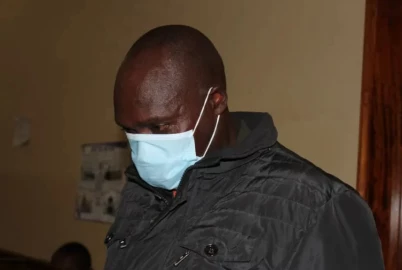
Police Constable Jackson Konga during a past court appearance.
Mulembe Times | July 24, 2025
A Nakuru court has sentenced Police Constable Jackson Kipkoech Konga to 30 years in prison for the murder of his superior officer, Sergeant Christopher Kimeli, in an incident that shocked the police service and the country at large.
The fatal shooting occurred on the morning of August 8, 2023, at the Kenya Police Dog Unit (K9 Unit) in Nakuru East Sub-County, where both officers were stationed.
According to court documents and witness accounts presented during the trial, an argument erupted between Konga and Sergeant Kimeli during a routine morning briefing. Sergeant Kimeli reportedly reprimanded Konga over his alleged failure to properly handle and process overnight suspects. The reprimand is said to have angered the junior officer, leading to a heated exchange.
During the altercation, Constable Konga retrieved his official firearm. Testimonies revealed that after briefly walking away from the scene, he returned, cocked the weapon, and fired at Kimeli at close range, fatally wounding him. The shooting happened in full view of fellow officers, who later testified in court.
Konga surrendered shortly after the shooting and was arrested without resistance. He reportedly told colleagues, “I’ve finished him, I’m now a civilian,” according to police witnesses.
In his defense, Konga claimed that the shooting was accidental and occurred during a physical struggle between him and his boss over the firearm. He told the court that the gun discharged during the scuffle and insisted that Sergeant Kimeli had also fired a shot during the struggle. However, the prosecution successfully argued that the killing was premeditated, citing eyewitness accounts and ballistic evidence.
In delivering the judgment, Justice Julius Nangea of the Nakuru High Court dismissed Konga’s claim of accidental discharge and ruled that the constable had acted with intent and recklessness. The court acknowledged that Sergeant Kimeli’s remarks may have provoked Konga, but held that the reaction—resorting to lethal force—was grossly disproportionate and deliberate.
“The accused was indeed provoked. However, provocation does not justify killing. He had the opportunity to walk away or seek redress through internal disciplinary channels. Instead, he chose to respond with fatal violence,” Justice Nangea stated.
The judge added that the killing of a superior officer, especially while in uniform and in the line of duty, amounted to a serious breach of discipline and an assault on the integrity of the police service.
Given the gravity of the offense and its implications for public trust in law enforcement, the court sentenced Konga to 30 years in prison, with the judge noting that a harsh sentence was necessary to serve as both punishment and deterrent.
The sentencing has attracted widespread attention, particularly due to the ongoing national conversations around discipline within the police force and mental health support for officers in high-stress roles.
The National Police Service (NPS) has not issued a public statement following the ruling, but senior sources indicate that internal reviews are underway to evaluate protocols for handling internal disputes and officer welfare.
Konga now begins serving his 30-year term behind bars, marking a grim end to a case that has shaken the Nakuru police ranks and sparked renewed calls for reform and better conflict resolution mechanisms within the service.