


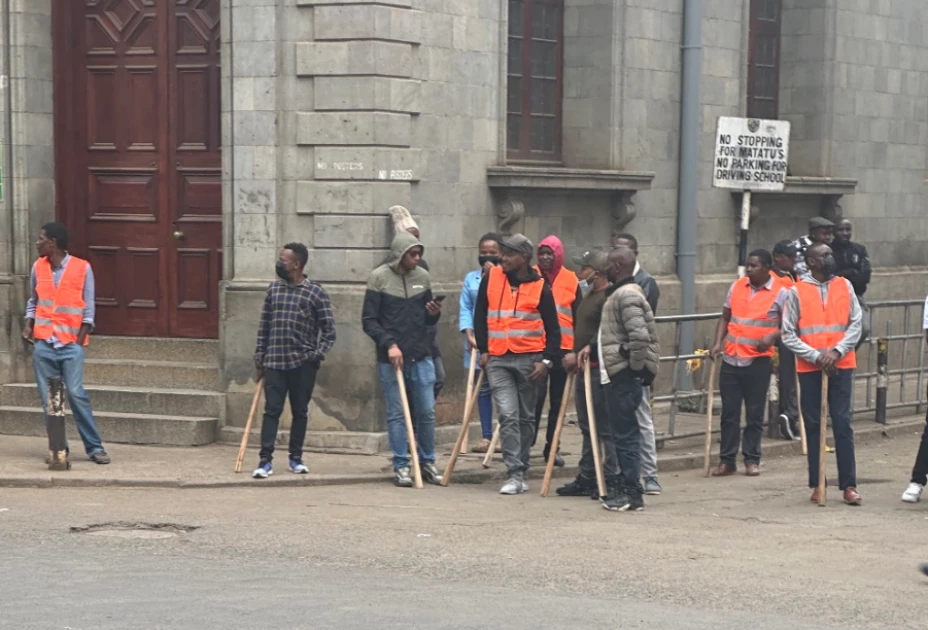
Hired gangs armed with crude weapons joined police officers to terrorize protesters in Nairobi. Who is behind this alarming alliance undermining the rule of law?
What began as a planned protest in Nairobi’s Central Business District (CBD) quickly spiraled into a chilling display of lawlessness as police officers and unidentified, armed civilians—commonly referred to as goons—worked hand in hand to disperse and terrorize demonstrators. The disturbing collaboration has sparked outrage and renewed concerns over the Kenyan government’s approach to managing dissent and public assembly.
Under the cover of law enforcement, men on motorcycles arrived in groups, wielding sticks, jembe handles, whips, and other crude weapons. Eyewitnesses reported that these hired thugs—clearly ununiformed and unbadged—moved with confidence, often taking the frontline in confrontations with protesters. Even more troubling was the visible coordination between the gangs and uniformed police officers, who appeared not only to tolerate but to facilitate their actions.
This is not the first time such a pattern has been witnessed. Similar scenes unfolded during earlier protests in Kakamega, Kericho, and Uasin Gishu, where groups of civilians showed up with new farming tools, which were then used as weapons to attack anti-government demonstrators. However, the Nairobi incident is perhaps the most brazen and public indication yet of a disturbing shift in how the state enforces order—by outsourcing its authority to shadowy civilian militias.
The spectacle challenges the very ethos of the National Police Service (NPS), whose motto, “Utumishi kwa Wote” (Service to All), now rings hollow. Instead of upholding constitutional rights and protecting all Kenyans equally, the NPS appears to be selectively partnering with non-state actors to enforce political will—outside the bounds of legality.
Nairobi Governor Johnson Sakaja added fuel to the fire just days before the protests. In a strongly worded warning, Sakaja said:
“This country must be a country under the rule of law. Let them not try again—they’ll find me in town!”
Though he did not explicitly call for force, his rhetoric was interpreted by many as a green light for a tougher crackdown. And indeed, what unfolded on Tuesday could be seen as a chilling fulfillment of that promise.
The presence of hired gangs raises serious questions:
- Who organized and deployed these civilians?
- Were they paid using public funds?
- Who is accountable if these individuals injure or kill a protester—or an innocent passerby?
So far, the government and the police service have remained tight-lipped. No arrests have been made in connection with the violence perpetrated by the goons. Human rights organizations have condemned the development, calling for an independent inquiry and urging the Inspector General of Police Japhet Koome to publicly disavow any collaboration with criminal elements.
“This is a dangerous descent into mob governance under police supervision,” said Ruth Odinga, a civil rights advocate. “If we normalize this behavior, we will soon be a country where gangs, not courts or laws, determine what is acceptable protest.”
Kenya’s 2010 Constitution guarantees every citizen the right to peacefully assemble and picket. Yet repeated incidents of police violence, excessive force, and now the outsourcing of public order duties to unidentified militias demonstrate a worrying erosion of constitutional protections.
In the absence of accountability, the fusion of state power and informal violence risks becoming entrenched. Not only does this endanger lives, but it also sets a perilous precedent for future dissent, be it against government policy, economic hardship, or political decisions.
As of today, neither Governor Sakaja nor the National Police Service has responded to requests for comment. But the citizens of Nairobi—and indeed all of Kenya—deserve answers.
In the meantime, the question remains: Who is behind the hired gangs terrorizing protesters in the heart of the capital? Until that is answered, Kenya’s democratic future hangs in the balance.


