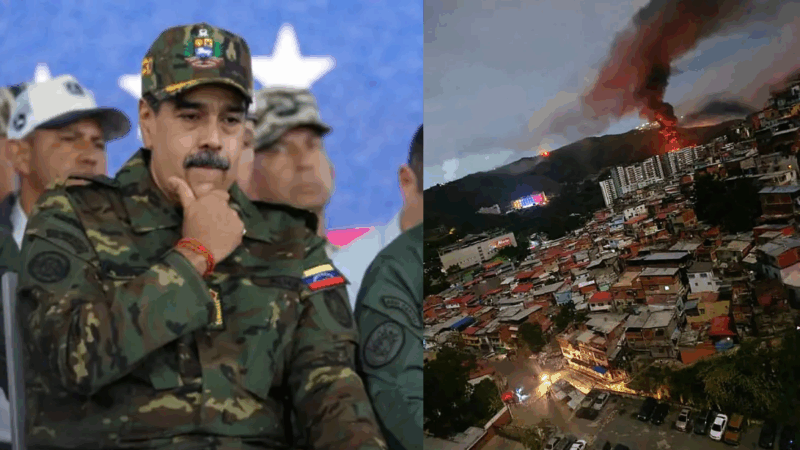
The United States launched a “large-scale military strike” on Venezuela early Saturday, January 3, an operation announced by U.S. President Donald Trump hours after explosions rocked the South American nation’s capital, Caracas.
In a statement posted on his Truth Social platform, Trump claimed that U.S. forces had captured Venezuelan President Nicolás Maduro and his wife, First Lady Cilia Flores, during the operation and flown them out of the country.
“The United States of America has successfully carried out a large-scale strike against Venezuela and its leader, President Nicolás Maduro, who has been, along with his wife, captured and flown out of the country,” Trump said.
Trump added that the operation was conducted “in conjunction with U.S. law enforcement agencies” and announced that he would address the matter further during a press conference scheduled for 11:00 a.m. local time at his Mar-a-Lago residence in Palm Beach, Florida.
Explosions Rock Caracas
Residents in Caracas reported hearing a series of loud explosions in the early hours of Saturday, triggering panic across parts of the city as people fled into the streets. Videos and images circulated widely on social media, showing flashes of light and plumes of smoke in the distance.
The Venezuelan government swiftly condemned the strikes, accusing Washington of carrying out an “imperialist attack” targeting both civilians and military installations. Officials said the assault lasted less than 30 minutes.
Venezuela Demands Proof of Life
Speaking by telephone to state television, Venezuelan Vice President Delcy Rodríguez said the government did not know the whereabouts of President Maduro or his wife and demanded proof of life from the United States.
“We do not know the whereabouts of President Nicolás Maduro and First Lady Cilia Flores,” Rodríguez said. “We demand proof of life.”
Caracas later declared a national emergency, denouncing what it described as “extremely serious military aggression” and vowing to pursue diplomatic and legal avenues in response.
Rising Tensions
Saturday’s attack marks a dramatic escalation in tensions between Washington and Caracas, which have intensified in recent weeks following threats by Trump to strike targets linked to drug trafficking networks allegedly connected to senior Venezuelan officials.
On December 31, the United States imposed sanctions on four entities accused of illegally operating in Venezuela’s oil sector, alongside blocking four oil tankers believed to be part of a “shadow fleet” funding Maduro’s government.
In a statement at the time, the U.S. State Department said the measures were intended to disrupt what it described as an “illegitimate and corrupt regime” and prevent sanctions evasion.
“Today’s sanctions continue President Trump’s pressure campaign on Maduro and his cronies,” the statement said.
Trump has repeatedly accused Maduro—without publicly presenting evidence—of leading a transnational drug trafficking organisation aimed at destabilising the United States.
Maduro Had Sought Dialogue
In an interview last week, President Maduro said Venezuela was open to negotiations with Washington on combating drug trafficking, while accusing the United States of attempting to overthrow his government to gain access to the country’s vast oil reserves, the largest proven in the world.
The full extent of the damage from Saturday’s strikes, the international response, and the legal implications of Maduro’s reported capture remain unclear as events continue to unfold.