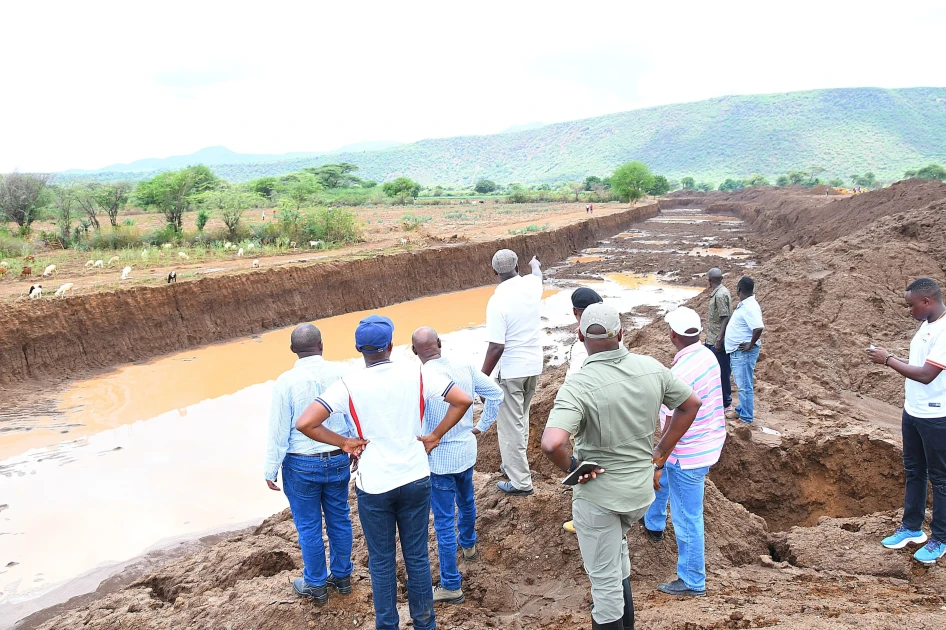
Ministry of Water officials, led by Irrigation PS Ephantus Kimotho, inspect restoration works in Baringo County. Photo: Ephantus Kimotho/X
Farmers and residents in Baringo County are counting losses following a government project to divert Rivers Waseges and Loboi in an effort to prevent Lakes Baringo and Bogoria from merging.
The intervention comes amid rising water levels that have submerged homes, displaced families and destroyed agricultural land around the two lakes.
Experts have warned that the distance separating Lake Bogoria, an alkaline lake, and Lake Baringo, a freshwater lake, has narrowed to approximately seven kilometres, raising concerns about a possible ecological disaster if the two water bodies connect.
To address the situation, the government has deployed more than 100 excavators and other heavy machinery to restore the rivers to their original courses and manage water flowing into Lake Bogoria.
Irrigation Principal Secretary Ephantus Kimotho said Rivers Waseges and Loboi historically channelled their water towards Lake Baringo before siltation altered their drainage patterns.
“The two rivers used to channel their water to Lake Baringo, but because of siltation over time, they have been taking water to Lake Bogoria. In fact, 60 per cent of the water in Lake Bogoria comes from the two rivers. So, part of the works we are doing is river training,” Kimotho said.
He added that the government was constructing a 25-metre-wide channel to redirect water from River Waseges to the traditional Kimolong’o swamp.
However, while the project is intended to protect settlements and preserve the ecological balance of the two lakes, farmers along the affected rivers say the ongoing works have disrupted their livelihoods.
Linah Karatu, a farmer in Loboi, says the diversion has cut off irrigation water to her farms, threatening her agricultural investments and family income.
Karatu has ten acres under maize cultivation and another three acres of tomatoes in Sandai.
She said farmers were not adequately prepared for the interruption of irrigation water, particularly because they had already planted their crops.
“I used to use this water from Sandai to grow tomatoes, beans and maize. Now that we have already planted and they have closed the canal, we don’t know what to do. We thought that before diverting this water, they would construct irrigation canals first,” she said.
Other farmers have also complained that excavation activities have damaged their crops, forcing some to uproot tomatoes and vegetables for replanting elsewhere.
Karatu said some farmers lost their crops after heavy machinery moved through their farms during the excavation works.
“When they excavated like that, there were people with farms; they trampled on tomatoes, they trampled on vegetables. Others uprooted their tomatoes to replant them elsewhere. But for those located right there, in what they claim is a swamp, they trampled over everything,” she added.
Families fear losing homes to river diversion
Further downstream along River Loboi, the government’s intervention has raised concerns among families whose homes and properties could be affected by the proposed river channel.
Some residents say they hold title deeds to their land and are worried about losing their properties as the government works to restore the river’s original course.
One resident questioned the maps being used to guide the project, arguing that they did not correspond with the actual situation on the ground.
“Everyone here has a title deed, even me, I have mine. We have spoken with the county government, but they have done nothing,” the resident said.
“We have seen the maps of this area and we don’t find any river here. So why is the government showing us maps that do not correspond with the work happening on the ground?”
The concerns come as authorities assess the extent of land affected by the diversion project.
According to the figures provided during the assessment, 21 plots have been affected along River Waseges, while another 80 plots are affected along River Loboi.
Loboi Centre faces uncertain future
At Loboi Centre, a once-vibrant tourism hub, residents are increasingly worried about the future as rising waters from Lake Bogoria continue to threaten surrounding settlements.
The situation has heightened fears that the centre could eventually be submerged, particularly with more heavy rains expected.
Although residents acknowledge the need to address the rising water levels and protect the two lakes, they say the government should also consider the economic impact of the intervention on communities living along the affected rivers.
They are calling for compensation for affected households and assistance for farmers who have lost access to irrigation water or suffered crop damage.
“We are appealing to the government to help us and also look into compensating the residents living here,” one resident said.
Government plans irrigation expansion
The government has indicated that the emergency river diversion works form part of a broader intervention programme targeting water management, environmental protection and agricultural development in the region.
Authorities have confirmed that the second phase of the project will involve upgrading irrigation infrastructure to ensure farmers can access water for agricultural production.
About 250,000 acres have been identified as having potential for irrigation development in Tiaty Constituency.
The proposed expansion is expected to support agricultural production and provide alternative economic opportunities for communities affected by the rising water levels.
However, residents say the immediate priority should be addressing the losses already incurred, restoring access to irrigation water and providing clear assurances to families whose homes and land could be affected by the project.