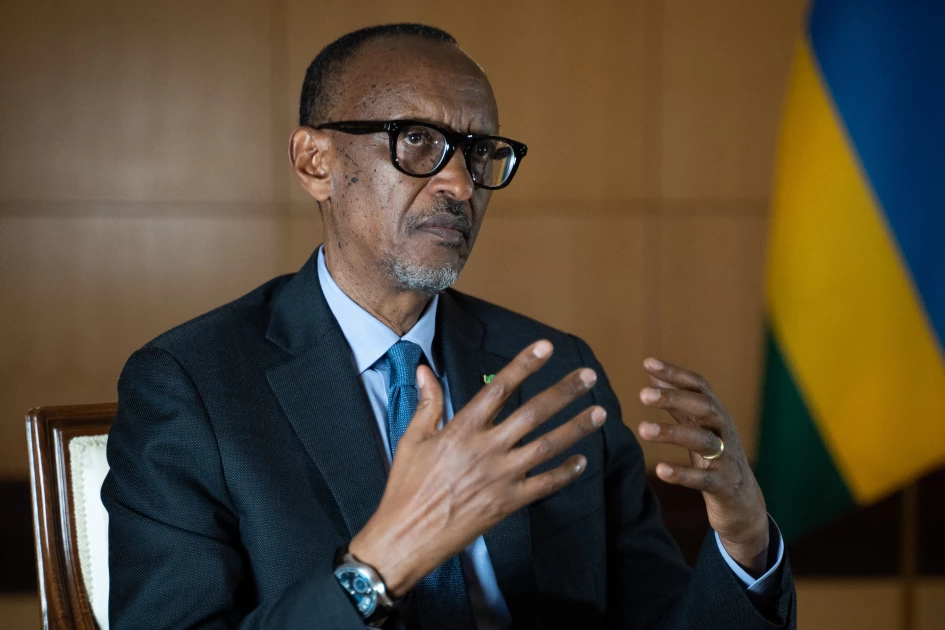
Rwanda’s President Paul Kagame speaks during an interview with international media at the presidency office in Kigali, on May 28, 2021. (Photo by Simon Wohlfahrt / AFP)
Mulembe Times – Kigali, Rwanda
Rwanda has confirmed that it is in the early stages of discussions with the United States to receive migrants deported from U.S. territory, further establishing itself as a willing partner for Western nations seeking to outsource their migration challenges.
Speaking in a televised interview on Rwanda TV, Foreign Affairs Minister Olivier Nduhungirehe revealed the development but cautioned that the talks are still ongoing and no formal agreement has been reached.
“We are in discussions with the United States,” Nduhungirehe said. “It has not yet reached a stage where we can say exactly how things will proceed, but the talks are ongoing… still in the early stages.”
Rwanda’s Growing Role as a Destination Country
This potential agreement would not be Rwanda’s first time participating in a migrant relocation plan with a Western power. In 2022, Rwanda signed a highly publicized deal with the United Kingdom to accept thousands of asylum seekers who had crossed into Britain irregularly. The agreement drew international attention—and controversy—but was eventually scrapped in 2024 under UK Prime Minister Keir Starmer.
Nonetheless, Rwanda has continued to signal its openness to acting as a relocation hub for migrants, citing its capacity, infrastructure, and commitment to international cooperation. Kigali argues that its involvement helps solve a global challenge and offers migrants a second chance in a peaceful, developing African nation.
Government officials have often framed Rwanda’s migration partnerships as part of its larger foreign policy agenda to enhance bilateral relations, strengthen global visibility, and attract development assistance.
Human Rights Concerns Persist
While the Rwandan government insists that it respects human rights and international refugee laws, critics say the country’s internal record does not align with that narrative. Human rights organizations have expressed deep concerns about Rwanda’s treatment of migrants and the country’s broader human rights landscape.
Key criticisms include limited freedom of expression, tight government control, and intimidation of political opponents, all of which raise concerns about whether deported migrants will be truly safe after arrival.
Groups such as Human Rights Watch and Amnesty International have previously questioned Rwanda’s suitability as a host for asylum seekers and vulnerable populations, urging Western nations to reconsider such deals.
Kigali Defends Its Record
In response to the criticism, Rwandan officials have defended their migration policies, accusing foreign critics of misunderstanding Rwanda’s development model and politicizing its international partnerships.
“Rwanda has proven that it can host migrants in dignity, safety, and with opportunity,” said a government spokesperson earlier this year in relation to its migration policies. “We are offering a solution, not creating a problem.”
The government maintains that all migrants relocated to Rwanda are given legal status, access to housing, health services, and the opportunity to integrate into society or seek permanent resettlement elsewhere.
Lack of Details on U.S. Talks
So far, the Rwandan government has released no information about how many migrants would be involved in the potential deal with the U.S., what legal mechanisms would support the transfers, or how long migrants would be expected to remain in Rwanda.
Analysts say that Kigali’s engagement with such programs serves a dual purpose: it boosts diplomatic ties with powerful nations while also reinforcing its image as a reliable African partner on the global stage.
But without greater transparency and safeguards, questions remain about the long-term impact on both migrants and Rwanda’s international reputation.
Conclusion
As Rwanda continues discussions with the United States, the world is watching. Kigali’s willingness to position itself as a destination for deported migrants places it at the center of a global debate on migration justice, sovereignty, and human rights.
Whether these talks will result in a formal agreement—and what that means for the deportees and Rwanda’s image—remains to be seen.