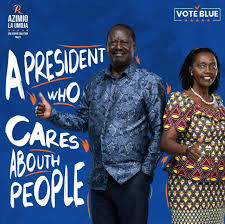
As the nation continues to mourn the death of former Prime Minister Raila Amolo Odinga, a wave of public discussion has emerged over what Kenya’s leadership structure would have looked like had Raila won the 2022 presidential election.
According to constitutional experts, Martha Karua, Raila’s running mate in the 2022 polls under the Azimio la Umoja One Kenya Coalition, would today be serving as President of the Republic of Kenya under the constitutional line of succession.
Article 146 (2) (a) of the Constitution of Kenya, 2010, provides that:
“If the office of President becomes vacant, the Deputy President shall assume office as President for the remainder of the term.”
This means that if Raila had taken office after the 2022 elections, his passing this week would have automatically triggered Karua’s succession. The Chief Justice would then have sworn her in as President within hours of the confirmation of his death.
No fresh election would be required. The transition would have been immediate and constitutional.
A Historic First for Kenya
Had that happened, Martha Karua would have made history as Kenya’s first woman President and one of only a few female heads of state in Africa.
Karua, a veteran politician and former Justice and Constitutional Affairs Minister, has long been a vocal advocate for the rule of law, transparency, and gender equality. Her ascension would have marked a symbolic victory for women’s leadership in Kenya, a country where no woman has ever held the nation’s top office.
“Karua’s presidency would have been both constitutional and monumental — a reflection of Kenya’s democratic maturity and gender progress,” said Dr. John Osogo, a political analyst based in Nairobi.
Political Landscape That Could Have Been
If Raila’s Azimio coalition had formed the government, Kenya’s political scene would now be under Karua’s leadership, likely with continuity of Raila’s policies.
Observers believe she would have retained most of Raila’s Cabinet initially to maintain political stability, before gradually reshaping it to reflect her own leadership style and agenda.
“Karua’s approach to governance has always been firm, lawful, and reform-driven,” said Dr. Mercy Wafula, a governance scholar. “Her presidency would have been characterized by strong accountability and institutional reforms.”
Given the widespread mourning over Raila’s death, analysts suggest that a Karua presidency under these circumstances would have enjoyed massive public sympathy, at least in the early months.
Her leadership would also have represented a milestone across Africa — joining the ranks of female presidents such as Ellen Johnson Sirleaf of Liberia, Sahle-Work Zewde of Ethiopia, and Samia Suluhu Hassan of Tanzania.
International observers note that such a transition would have enhanced Kenya’s global image as a model of constitutionalism and peaceful transfer of power.
Karua’s Current Political Path
In reality, Karua is now an opposition leader and has already declared her intention to run for the presidency in 2027 under the People’s Liberation Party (PLP).
Following Raila’s death, she has emerged as one of the key voices within Azimio calling for unity, respect for democracy, and the continuation of Raila’s reform agenda.
“We must honor Raila’s legacy by fighting for justice, integrity, and democracy,” Karua said earlier this week in a statement of condolence.
While history took a different turn after the 2022 elections, the discussion around Martha Karua’s potential presidency underscores the significance of Kenya’s constitutional safeguards and the enduring legacy of the Raila–Karua partnership.
Their 2022 ticket, which came within striking distance of victory, continues to shape national conversations about leadership, gender equality, and the future of Kenya’s democracy.