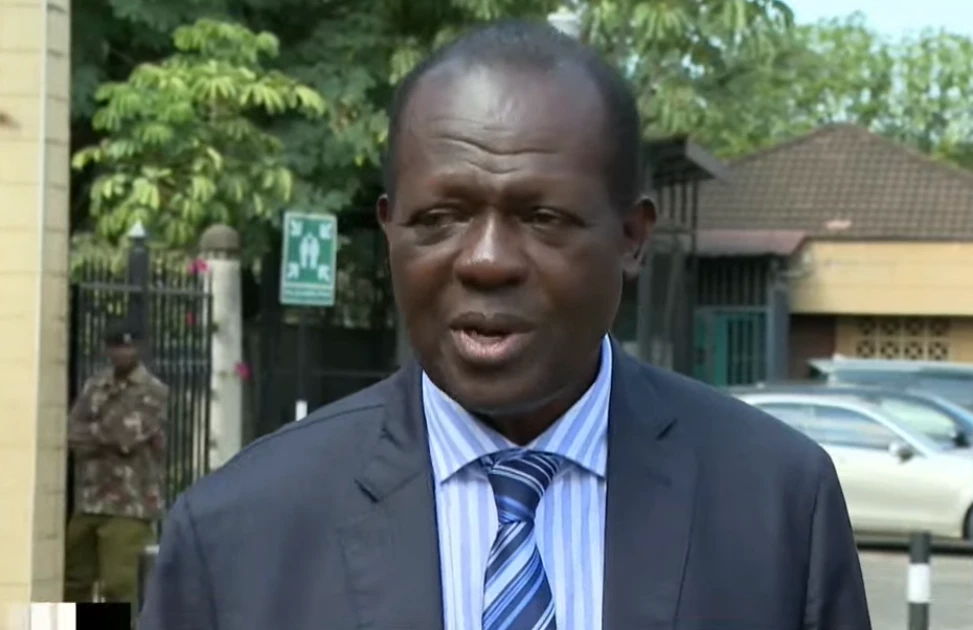
Raphael Tuju addresses the press outside Supreme Court buildings after delivering the letter to CJ Martha Koome on March 13, 2026.
The High Court has granted former Cabinet Secretary Raphael Tuju an anticipatory bond of Ksh.200,000 following his claims of imminent arrest and alleged harassment by law enforcement agencies.
Tuju moved to court under a certificate of urgency, arguing that his rights and freedom were under threat due to what he described as persistent surveillance and intimidation by security agencies.
Claims of Harassment and Surveillance
In his application, Tuju told the court that he was trailed by unmarked vehicles on March 21, forcing him to abandon his car and seek refuge in a secure location for his safety.
He further claimed that he later presented himself at Karen Police Station to record a statement, but was allegedly manhandled by officers during the process.
According to court documents, the incident worsened injuries he had previously sustained in an aeroplane crash and a separate motor vehicle accident.
Orders Sought Against State Agencies
Through his legal team, Tuju is seeking orders to restrain several state agencies from interfering with his liberty.
These include the National Police Service under the Inspector General, the Directorate of Criminal Investigations (DCI), and the Office of the Director of Public Prosecutions (DPP).
He is asking the court to bar them from summoning, arresting, or otherwise interfering with his freedom of movement as investigations continue.
Tuju has also requested the court to ensure that he can access medical treatment without intimidation or the presence of police officers.
Court Declares Matter Urgent
Presiding over the matter, Justice Martin Muya certified the application as urgent and granted the anticipatory bond pending further directions.
The case is scheduled to be mentioned on April 7, 2026, when the court is expected to give further guidance on the matter.
Legal and Political Implications
The case adds to a growing list of legal battles involving high-profile political figures, raising concerns about the relationship between law enforcement agencies and political actors.
Legal experts note that anticipatory bonds are typically issued to protect individuals from unlawful arrest, especially where there is evidence of potential abuse of power.
As the case progresses, attention will be on how the court balances the rights of the applicant with the mandate of investigative and prosecutorial agencies.