


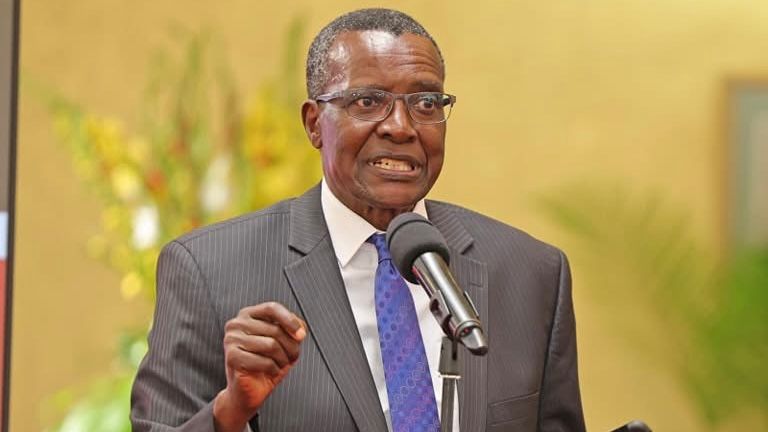
Former Chief Justice David Maraga has argued that the court should have completely annulled former Deputy President Rigathi Gachagua’s impeachment after finding that he was denied a fair hearing, warning that awarding compensation instead risks encouraging constitutional violations by public officers.
Speaking in an interview with Spice FM, Maraga said that once the court established that Gachagua’s right to a fair hearing had been violated, the only logical legal remedy should have been to invalidate the entire impeachment process.
“The court finds that Honourable Gachagua was not given a fair hearing and he has been impeached. In my view, after that finding, the inevitable conclusion should have been to annul that impeachment,” he said.
Maraga, who also leads the United Green Movement (UGM), acknowledged the court’s reasoning that the impeachment process had already been completed and a new Deputy President had been appointed, making reinstatement legally and practically complex. However, he disagreed with the remedy adopted.
He noted that even though Rigathi Gachagua himself did not seek reinstatement as Deputy President in his petition, the violation of the right to a fair hearing remained central and should have led to the nullification of the Senate process.
He further criticised the decision to award compensation instead of overturning the impeachment, arguing that such rulings could weaken accountability in public office.
“Government officers will continue violating the Constitution knowing that they will not be punished individually. We will be entrenching the culture of impunity,” he warned.
Maraga also referenced Article 25 of the Constitution, which protects the right to a fair hearing as one of the non-derogable rights that cannot be limited under any circumstances.
“The right to a fair hearing is sacrosanct… it cannot be limited,” he said, adding that allowing the impeachment to stand despite the violation sends the wrong message that constitutional rights can be traded for financial compensation.
The former Chief Justice further revisited his controversial 2020 advisory to President Uhuru Kenyatta recommending the dissolution of Parliament over failure to implement the two-thirds gender rule.
A recent High Court ruling declared the advisory unconstitutional on procedural grounds, stating that the relevant court order had not been formally transmitted to the Speakers of Parliament.
Maraga, however, questioned the ruling, arguing that parliamentary lawyers were present when the order was issued and that Parliament had already appealed and lost the case.
“You have to read the spirit of the Constitution. The same Constitution says substantive justice should not be undermined by procedural technicalities,” he said, citing Article 159(d).
The remarks add fresh weight to ongoing legal and political debate over constitutional interpretation, impeachment procedures, and remedies for violations of fundamental rights in Kenya’s governance system.


