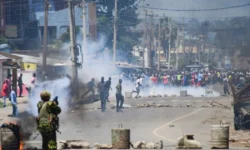
University students have issued a 24-hour ultimatum to the government, warning that they will join striking lecturers if the ongoing pay dispute is not resolved promptly.
The lecturers’ strike, which has paralyzed learning across public universities, has left lecture halls deserted and students anxious about their academic future. Many institutions have suspended classes indefinitely, raising fears that the entire semester could be lost if a solution is not reached soon.
At the heart of the strike is a demand by lecturers for the government to settle arrears owed under the 2017–2021 Collective Bargaining Agreement (CBA). The dons, through their unions, are also pressing for the immediate commencement of talks on a new 2025–2029 CBA. They argue that failure to address their concerns has forced them to down tools, a move that has plunged higher education into uncertainty.
For students, the impact is already being felt. With examinations just weeks away, learners say they are stranded and unable to make progress in their studies. At Kenyatta University, students voiced strong frustration over the government’s handling of the crisis.
“We demand a concrete, publicly stated plan for recovering lost time, including a revised academic calendar. Otherwise, this disruption will become a lost semester or delay graduation for thousands of students,” said Victor Omondi, a student leader.
Another student, Desmond Mbare, criticized what he described as government inaction, saying the youth will not sit idly by as their dreams are delayed. “There’s an ongoing strike of lecturers. We shall not sit back and relax while these people are delaying our dreams in this nation,” he declared.
Valentine Nyanchama, also from Kenyatta University, warned that if the situation remains unresolved, students could take to the streets to demand action. “Exams are around the corner, yet no learning is happening. If nothing changes, we will have no choice but to protest,” she said.
The Ministry of Education has yet to announce a breakthrough in negotiations, though officials insist that discussions with lecturers’ unions are ongoing. Previous industrial actions have had lasting effects on public universities, with strikes often stretching academic years and pushing graduations far behind schedule.
Education experts warn that prolonged disruption could have wider consequences. Not only could it affect students’ academic timelines, but it could also erode confidence in public universities, driving more learners to private institutions or overseas programs. For a country already grappling with high youth unemployment, interruptions in higher education are seen as a serious setback.
Student leaders say their call to join the strike is not meant to escalate tensions but to pressure the government into delivering a swift resolution. They argue that both students and lecturers share a common interest: the right to fair learning and working conditions.
As the 24-hour deadline draws closer, attention now turns to the government’s next move. Without an immediate solution, Kenya’s universities face the prospect of a crisis deepening—one that could cost not only classroom time but also the trust of a generation of students whose futures hang in the balance.
Image by The Standard