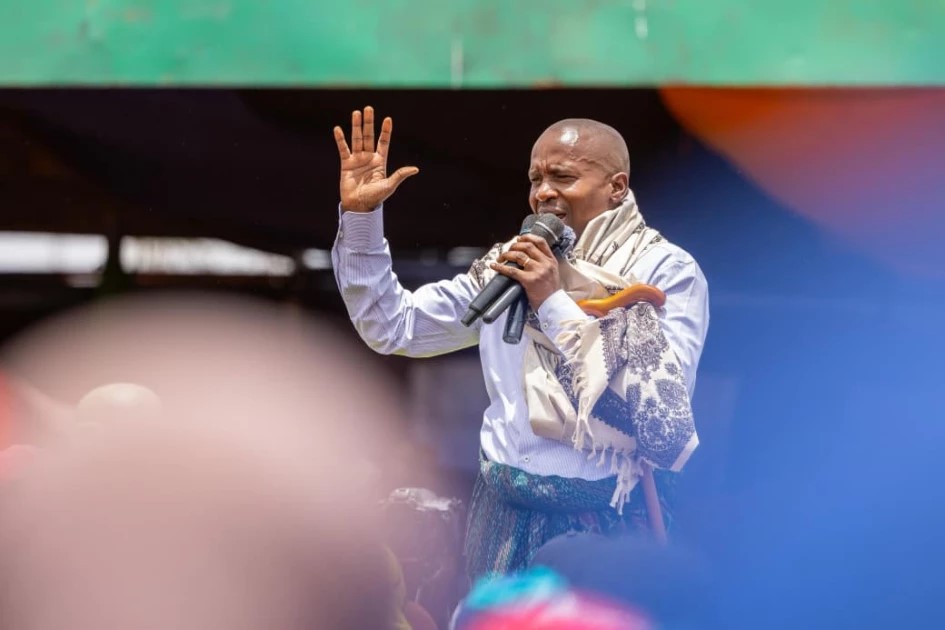
Deputy President Kithure Kindiki has pledged that the Kenya Kwanza administration is determined to end decades of neglect in North Eastern Kenya, promising the region will no longer be left behind in the country’s development roadmap. Speaking at economic empowerment events across the area, Kindiki emphasized that under President William Ruto, there is a strong political will to ensure equitable treatment and rule out discriminatory practices.
Delivering addresses in towns including Elwak (Mandera County) and Wajir, Kindiki said the government is rolling out major development projects across North Eastern counties—Mandera, Wajir, Garissa, Marsabit, and Isiolo—in infrastructure, energy, housing, and public services. He described the region’s historical marginalization as unfair and vowed that Kenya’s development will now be inclusive. “If projects are being rolled out in Nairobi, then the same must happen in North Eastern, in Coast, in Nyanza, in every part of Kenya,” he stated.
Among the flagship infrastructure projects Kindiki highlighted is the 750-kilometre road corridor linking Isiolo, Modogashe, Wajir, Tarbaj, Kotulo, Rhamu, and Mandera. Valued at about KSh 100 billion, the road is expected to open up trade, ease movement, and spur economic activities in remote areas. Investments in modern markets, affordable housing, and electricity connectivity are also underway. For instance, hybrid power plants are being built in Elwak, Merti, Eldas, and Habaswein, while solar projects and improved power grid links are planned for Garissa.
Kindiki also pointed out that discriminatory policies—especially those surrounding national identification documentation and vetting criteria—have been reformed. The government has streamlined processes for acquiring IDs, seeking to eliminate delays and unfair hurdles that for years had disenfranchised many residents of Northern Kenya.
At public meetings, Kindiki has urged leaders and communities in the North Eastern region to collaborate with the government to ensure that the policies and projects translate into real gains for ordinary people. He said that stopping at promises is not enough; residents must see roads, reliable electricity, services like health care and schools, and housing delivered in full.
Local residents have responded with cautious optimism. Some recalled earlier announcements of development efforts that failed to materialize or were only partially completed. “We welcome what is being said today,” said a market trader in Elwak. “But we have waited many years. We hope this time it will be different.”
Political analysts say that Kindiki’s message is part of a broader push by Kenya Kwanza to demonstrate its commitment to devolution and regional equity ahead of the 2027 elections. The North Eastern region has long felt excluded from national development due to geography, infrastructure gaps, and weak public services. Kindiki’s statements and the visible projects appear aimed at closing that divide.
Still, the challenge will be in implementation. Budgets must flow, contractors must deliver, and bureaucratic delays need to be minimized. These measures, if successful, could build trust with communities that have historically felt marginalized. If not, the rhetoric risks being seen as political theatre.
For North Eastern Kenya, these are pivotal moments. The government’s promise to end historical marginalization brings hope; the coming months will test whether that hope is translated into roads driven, lights switched on, and lives tangibly improved.
IMAGE : CITIZEN DIGITAL