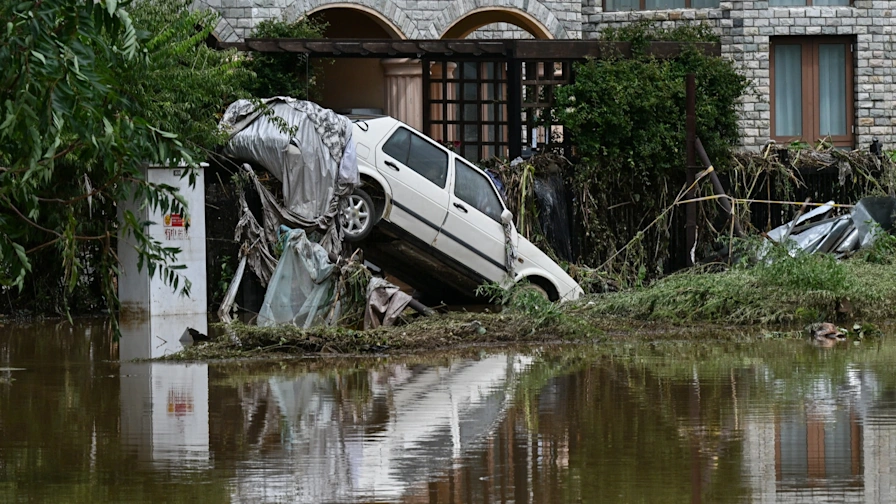
At least 44 people have lost their lives following days of torrential rains that swept across central and eastern Mexico, unleashing devastating floods and landslides. The deluge, caused by Tropical Storms Priscilla and Raymond, has left a trail of destruction in several regions, prompting emergency responses and widespread evacuations.
According to government reports, the hardest-hit states include Veracruz, Hidalgo, Puebla, and Querétaro. Veracruz has reported the highest death toll, with 18 confirmed fatalities, followed by 16 in Hidalgo, nine in Puebla, and one in Querétaro. The unrelenting rains caused rivers to burst their banks, washing away homes, vehicles, and farmlands while leaving communities stranded.
Images shared by local authorities and the military show entire neighborhoods submerged in muddy floodwaters. In Poza Rica, Veracruz, the Cazones River overflowed, inundating nearby villages and forcing residents to seek refuge on rooftops. Rescuers have been using inflatable boats to reach affected families, as several roads remain impassable.
President Claudia Sheinbaum has declared a state of national emergency, activating the National Emergency Committee to coordinate rescue and relief operations. The president confirmed that over 130 towns have been affected and urgently need humanitarian assistance. Sheinbaum praised the efforts of first responders, including the military, navy, and civil protection teams, who continue to carry out rescue missions despite treacherous conditions.
In Hidalgo, authorities reported extensive damage to infrastructure. More than a thousand homes, 59 healthcare facilities, and over 300 schools have been affected. Power outages have also disrupted life in many areas, leaving thousands without electricity or access to clean water. In Puebla, multiple villages have been cut off due to landslides and road collapses, making it difficult for emergency teams to deliver food and medical supplies.
Experts have blamed poor drainage systems, unchecked deforestation, and weak enforcement of building regulations for worsening the disaster’s impact. Many flood-prone communities have been built near rivers or on unstable slopes, leaving residents vulnerable whenever heavy rains strike. Environmentalists are now urging the government to adopt stricter land management policies and invest in climate resilience programs to prevent similar tragedies in the future.
The National Water Commission has warned that more rain is expected in the coming days, heightening the risk of additional floods and landslides. Residents in mountainous and low-lying regions have been advised to move to safer ground and stay alert for evacuation orders.
Humanitarian groups have stepped in to support relief efforts, providing food, clean water, and temporary shelters to displaced families. Meanwhile, government agencies are assessing the full extent of the damage, which is expected to run into billions of pesos.
As the nation mourns, President Sheinbaum called for solidarity, urging Mexicans to come together in the face of tragedy. “This is a time for unity and compassion,” she said in a televised address. “We will rebuild, and we will ensure that every affected family receives the help they need.”
The devastating floods have become one of the deadliest natural disasters to hit Mexico this year, underscoring the country’s growing vulnerability to climate-induced weather extremes.
PHOTO : AP NEWS