Though the late Raila Amolo Odinga is no longer with us, his influence continues to echo in Kenya’s streets. In recent days, his absence has seemed almost strategic , a silent summons that has drawn supporters across the country outward, uniting them in grief, remembrance, and political expression.
Even before his body touched down in Nairobi, signals had begun to appear: veiled calls via social media, waves of floral tributes around key public spaces, and sudden gatherings of youth groups in towns and cities. These actions, though not openly directed, reflected an unspoken invitation from Odinga’s legacy , urging Kenyans to step out into public spaces, to bear witness, and to reaffirm the ideals he championed.
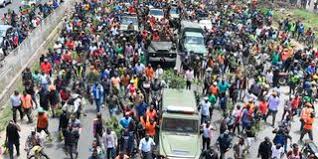
On Thursday evening, as flight RAO001 made its final descent into Kenyan airspace, crowds gathered around Jomo Kenyatta International Airport (JKIA) and along the expressway, waving branches and flags, demanding that the arrival of Odinga’s casket be visible to all. In Nairobi’s CBD, smaller spontaneous gatherings greeted reporters and motorists: whispers, chants, and chants of “Baba! Baba!” rose from pockets of mourners as they tried to glimpse the procession.
By the time his body lay in state at Parliament Buildings, the grounds were thronged not only by officials but by ordinary citizens who had drifted toward the locus of mourning. Security walls were scaled, barricades crossed, and in some instances, gridlock reclaimed major roads. The presence of President William Ruto, former President Uhuru Kenyatta, and senior officials brought political weight to the moment, but it was the sea of silent supporters who painted the true scale of Odinga’s pull.
Observers say this mobilization was not engineered in the moment; it was the fruit of years of building. Odinga’s charisma, his message of equity and inclusion, and the symbolic power he carried allowed his followers to act without direct instruction. In communities across Kisumu, Siaya, Kibera, and beyond, followers assembled quietly at crossroads and markets, holding vigil in the early hours ahead of the public funeral.
The morning at Nyayo National Stadium functioned as the culmination of these quiet mobilizations. Tens of thousands marked their presence not only to see his casket, but to affirm that his message remains alive. Flags were held high, hymns and eulogies echoed, and many stood in silence, as if speaking through absence itself.
Even as the nation mourns, his funeral committee has hinted that the gathering is part ritual, part political statement. Odinga’s death is not just a farewell — it is a passage. The appointment of Senator Oburu Oginga as acting ODM leader, the public holiday declared in his name, and the crowd’s turnout all point to an emerging transition: one driven not by force, but by inspiration.
In his final days, Odinga may have been physically absent, but his presence was felt more acutely. His silence summoned a people, and in their movement, his story continues.
Image by Daily Nation