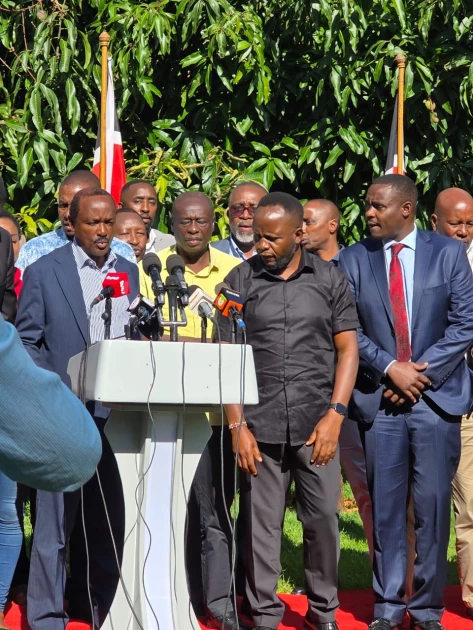
The United Opposition coalition has issued a stern warning to President William Ruto, urging him not to underestimate their growing political strength as the country edges closer to the 2027 General Election.
Speaking during a joint press briefing on Sunday, coalition leaders declared that the political landscape had shifted significantly since 2022, and that the opposition now stood “more united, organized, and determined than ever before” to challenge Ruto’s administration both in the upcoming by-elections and in the next national vote.
The coalition’s remarks came in direct response to the President’s recent comments suggesting that the late former Prime Minister Raila Odinga was his only serious challenger ahead of 2027. Opposition leaders dismissed this claim as “outdated and misleading,” saying Ruto would soon realize that he now faces a new, broader political force.
Unity in Action: One Candidate Per Seat
In a strategic move aimed at consolidating support and eliminating internal rivalries, the United Opposition announced that it will field one joint candidate per electoral seat in the forthcoming November 27 by-elections.
According to the coalition’s statement, the goal is to avoid vote-splitting among opposition-affiliated parties, which has in the past benefited ruling party candidates. The joint ticket approach, leaders said, demonstrates the opposition’s maturity and readiness to govern as a unified bloc.
In Malava Constituency, the coalition has endorsed DAP–K’s Seth Panyako, after DCP candidate Edgar Busiega agreed to step down in his favour. Panyako will face off against UDA’s David Ndakwa, who enjoys strong backing from senior government officials, including presidential aide Farouk Kibet.
DAP–K party leader Eugene Wamalwa hailed the agreement as a demonstration of selflessness and political foresight.
“We have been saying one term, but that is not possible if we are not one team,” Wamalwa said. “Busiega has made a great sacrifice to step down for Seth Panyako, and this shows our commitment to unity and to defeating UDA.”
In Mbeere, the coalition has settled on Democratic Party candidate Newton Karish, who will face UDA’s Muriuki Wamuthende, while in Magarini, Wiper Party’s Nzai Samuel stepped aside for DCP’s Stanley Kenga, setting up a showdown with ODM’s Harrison Kombe.
Wiper leader Kalonzo Musyoka praised the spirit of compromise among opposition parties, confirming that Wiper had also ceded space in Malava for the DAP–K candidate.
“We affirm our decision to cede ground for DAP–K because we believe in the bigger picture,” Kalonzo said. “It is not about positions — it is about rescuing this country from misrule.”
UDA Defiant as Battle Lines Are Drawn
Despite the united front, the ruling United Democratic Alliance (UDA) maintains confidence that it will retain dominance in the by-elections.
While rallying support for Ndakwa in Malava, Farouk Kibet, a close ally of President Ruto, urged voters to back the UDA candidate, claiming he was best positioned to deliver government-backed development projects.
“We must focus on leaders who can work with the government to bring services to the people,” Kibet said. “Malava deserves development, not endless political quarrels.”
Tensions Rise Ahead of 2027
The political temperature continues to rise as the opposition intensifies its messaging, accusing the Kenya Kwanza administration of poor governance, high taxation, and disregard for civil liberties.
One senior opposition leader, addressing supporters in Kakamega, declared:
“We want to tell the President that his opponents are not individuals — his opponents are the people of Kenya.”
Meanwhile, in Magarini, ODM leaders — whose party remains part of the ruling coalition — fired back at the united opposition, accusing some of its figures of reviving ethnic-based politics.
“Do you want tribalism brought to Magarini?” ODM National Chairperson Gladys Wanga asked supporters during a rally.
Political analysts say the united opposition’s new structure could present a formidable challenge to both UDA and ODM if sustained through 2026. The success of the joint-candidate strategy in the by-elections will likely determine whether the coalition can build the momentum needed for a credible presidential challenge in 2027.
For now, Kenya’s political arena is shaping up for a fierce battle — one that may redefine alliances and set the tone for the next electoral cycle.