


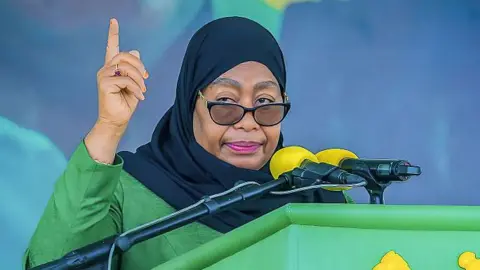
When Tanzanians went to the polls on October 29, 2025, the world’s gaze turned toward a nation once hailed as a democratic model in East Africa. This was the same country that gave the region its first female president — Samia Suluhu Hassan. Yet, beneath the surface of celebration lay an atmosphere of fear, repression, and silence.
This year’s election was one to watch. President Suluhu’s administration faced mounting accusations of undermining democracy, silencing dissent, and weaponizing state power to ensure a one-party victory for the ruling Chama Cha Mapinduzi (CCM).
But as the voting concluded and the results emerged, one chilling truth became clear: Tanzania had gone dark — literally and metaphorically.
An Election Without Opponents
In the presidential race, Samia Suluhu Hassan effectively ran unopposed. The main opposition party, Chadema, was barred from contesting both the presidential and parliamentary elections on April 12, 2025.
This came after Tundu Lissu, Chadema’s outspoken leader, was arrested at a rally for calling for electoral reforms and later charged with treason — a move condemned internationally as politically motivated.
With Lissu imprisoned since April, other Chadema leaders also faced state harassment. John Heche, the party’s deputy chairperson, was detained on October 22, in what opposition supporters called “a calculated effort to neutralize dissent before the vote.”
By election day, Tanzania’s democratic institutions had been reduced to silence.
A Nation in the Dark
As polling began, local media provided little insight. State broadcaster Tanzania Broadcasting Corporation (TBC) gave brief, sanitized updates before cutting back to entertainment programmes.
When the electoral commission declared Suluhu the winner with 98 percent of the vote, there were no street celebrations — only silence and fear.
Even the inauguration ceremony, once a public event held in packed stadiums, took place behind closed doors at the State House in Dodoma, with no civilians allowed and no independent media coverage.
That same night, Dar es Salaam fell under a military-enforced curfew. Police Commander Jumanne Muliro announced that movement would be restricted from 6:00 p.m. onward, without indicating when the curfew would end. Soldiers patrolled streets that had already fallen eerily quiet.
Then the lights went out — power cuts, internet blackouts, and media silence plunged Tanzania into isolation.
“Among the last verifiable tweets I saw,” wrote one journalist, “was that of President Suluhu casting her vote and displaying her ink-stained finger — just hours before the cameras, lights, and connections went off.”
A Bleeding Nation
The internet blackout has made it nearly impossible to verify reports emerging from within the country. Yet fragments of truth continue to filter through, painting a picture of tragedy.
According to Agence France-Presse (AFP), hundreds — perhaps thousands — have died since protests broke out on election day.
Chadema officials claim that about 700 people were killed in post-election violence, though these figures remain unverified due to government-imposed media restrictions.
At the same time, shortages of food, fuel, and cash have gripped the nation, worsened by the communication shutdown.
A travel advisory by the UK’s Foreign, Commonwealth & Development Office (FCDO) warned citizens to avoid all but essential travel to Tanzania, citing “uncertainty around international transport options” and a lack of essential supplies.
The U.S. Embassy has issued similar guidance, advising staff to remain indoors and adhere to local curfews.
Kenyan music publicist Anyiko Woko, stranded in Dar es Salaam during the unrest, told the BBC that she only managed to leave on Saturday morning after being stuck for days.
“Many Tanzanians are unable to share their own stories,” she said. “They’re trapped at home or at work, with no food, no water, and no internet.”
Flight tracking data from FlightRadar captured at 9:45 a.m. EAT showed only three aircraft in Tanzanian airspace — a stark contrast to the bustling skies of neighbouring Kenya and Uganda.
Misinformation in the Shadows
With mainstream and international journalists locked out or denied accreditation, disinformation has flourished.
AI-generated videos and old footage have flooded social media, falsely depicting chaos, military coups, and even claims that President Suluhu fled to Uganda — a video later traced to her 2021 visit to Mwanza.
The vacuum of verified news has turned TikTok and X (Twitter) into battlegrounds of misinformation, where truth and falsehood are indistinguishable.
Voices for Peace
Amid the darkness, global leaders have called for calm and dialogue.
African Union Commission (AUC) Chairperson Mahmoud Youssouf congratulated President Suluhu on her re-election but expressed “deep regret over the loss of life” and urged respect for human rights and political pluralism.
From the Vatican, Pope Leo XIV offered prayers for the nation:
“May we also #PrayTogether for #Tanzania, where, following the recent elections, violent clashes have broken out. I urge everyone to avoid all forms of violence and to follow the path of dialogue.”
UN Secretary-General António Guterres also condemned the violence, calling on all parties to exercise restraint.
“I call on all to reject violence and engage in inclusive, constructive dialogue to prevent further escalation,” Guterres said.
The Southern African Development Community (SADC) echoed similar appeals, with Malawi’s President Arthur Peter Mutharika, Chairperson of SADC’s security organ, urging Tanzanian stakeholders to “refrain from actions that may further inflame unrest.”
The Silence of a Nation
For now, Tanzania remains shrouded in silence — its people disconnected, its journalists silenced, and its future uncertain.
The lights are off, the cameras are off, and a once vibrant democracy bleeds quietly in the dark.


