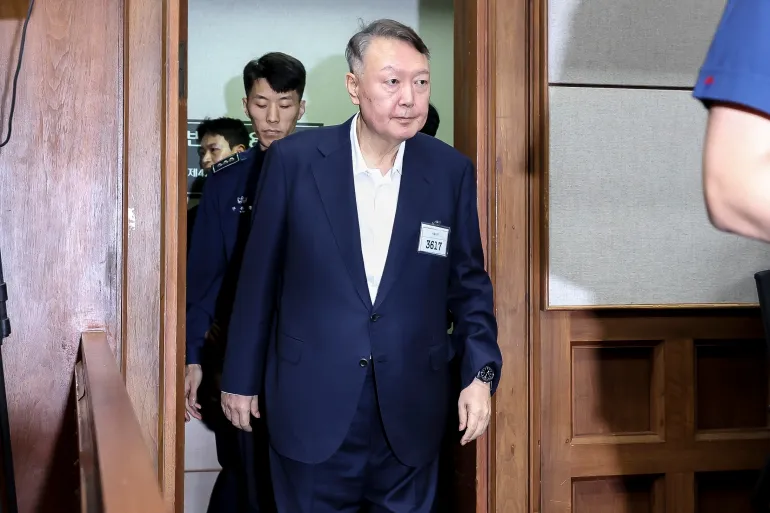
South Korea’s former President Yoon Suk-yeol has been sentenced to life imprisonment after a court found him guilty of masterminding an insurrection linked to his controversial declaration of martial law in December 2024.
The verdict was delivered on Thursday by the Seoul Central District Court, bringing to a dramatic close one of the most politically consequential trials in South Korea’s modern history.
Presiding Judge Ji Gwi-yeon ruled that Yoon had acted outside the law and had attempted to paralyse the country’s democratic institutions through the use of force.
“The defendant flouted legal procedures and resorted to violent means to try to incapacitate the National Assembly of South Korea and undermine democratic norms,” the judge said while reading the court’s decision.
In an unusually direct rebuke, the judge added that the former leader had shown little remorse for the consequences of his actions.
“The declaration of martial law resulted in enormous social costs, and it is difficult to find any indication that the defendant has expressed remorse,” he said.
Moments later, the court delivered the final sentence.
“We sentence Yoon Suk-yeol to life imprisonment.”
Prosecutors had earlier urged the court to impose the death penalty, arguing that Yoon’s actions amounted to an organised and deliberate attempt to overthrow constitutional order.
The case stems from events that unfolded late on the night of December 3, 2024, when Yoon shocked the nation by declaring martial law, citing what he described as an existential threat posed by an opposition-controlled parliament.
In a televised address, Yoon branded the National Assembly a “den of criminals” and claimed that drastic action was necessary to eliminate what he referred to as “anti-state forces” operating within the political system.
Under the emergency decree, media organisations were placed under military supervision, political activities were suspended, and armed troops were dispatched to key state institutions.
Most dramatically, soldiers were sent to surround and raid the National Assembly complex, a move that immediately raised fears of a return to authoritarian rule in a country that has spent decades strengthening civilian democracy.
Public reaction was swift and defiant.
Thousands of citizens gathered outside the legislature within hours of the announcement, physically blocking troops and creating human barricades as lawmakers rushed into the chamber.
Inside the building, members of parliament convened an emergency session and voted to overturn the martial law decree, directly challenging the president’s authority.
Facing mounting pressure from both the public and political leaders, Yoon was forced to withdraw the order just six hours after it had been issued.
Despite the short duration of the emergency measures, prosecutors argued that the damage had already been done.
They told the court that the deployment of armed forces against an elected legislature constituted an attempted insurrection, even though the plan ultimately failed.
According to the prosecution, Yoon had abused presidential powers and sought to use the military to neutralise political opposition and intimidate democratic institutions.
The former president was arrested on January 15, 2025, following a tense and prolonged standoff between law enforcement agencies and members of his security detail at his official residence.
His detention marked a historic first: Yoon became the first sitting South Korean president to be arrested while still in office.
Throughout the trial, Yoon strongly denied the charges.
He dismissed the prosecution’s case as fictional and politically motivated, insisting that his actions were a legitimate exercise of constitutional authority during what he described as a national security crisis.
His defence team argued that the martial law declaration was intended to restore public order and stability, not to dismantle the democratic system.
However, the court rejected that claim, finding that the legal thresholds required for declaring martial law had not been met and that the measures taken went far beyond what could reasonably be justified under the constitution.
At the same time, the judges stopped short of accepting the prosecution’s most extreme allegation — that Yoon had intended to establish a long-term military-backed dictatorship.
Instead, the court concluded that while the former president had not laid out a clear blueprint for permanent authoritarian rule, his conduct still amounted to a grave assault on democratic governance.
Legal analysts say the ruling sends a powerful message about the limits of executive authority in South Korea and reinforces the principle that even the country’s most powerful officials remain subject to the rule of law.
Under South Korean law, Yoon has one week to lodge an appeal against the life sentence.
The verdict is expected to reverberate across the country’s political landscape, reshaping debates about presidential power, civil-military relations and the resilience of democratic institutions in the face of political crisis.