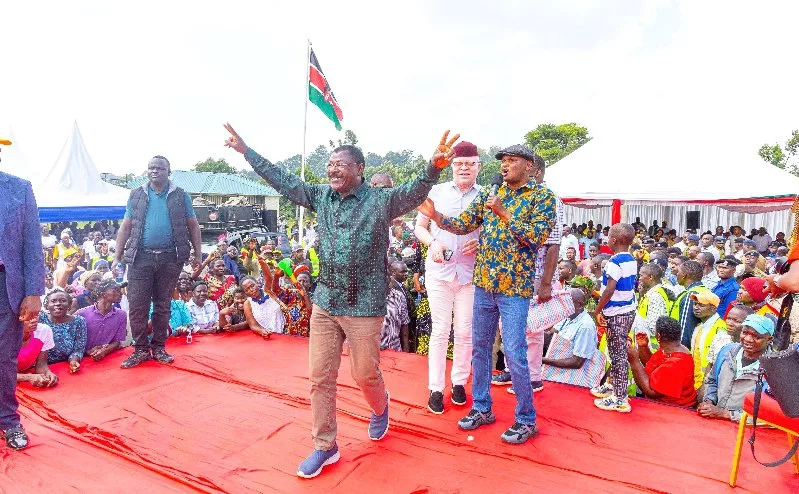
National Assembly Speaker Moses Wetang’ula arriving on the podium during a fundraiser in aid of Nangili ACK church in Matungu constituency on Sunday/IMAGE/HILTON OTENYO
As political preparations for the 2027 General Election gather pace, Western Kenya is once again facing a familiar dilemma: whether to unite behind a single political strategy or pursue competing ambitions that could weaken the region’s influence on the national stage.
The debate has shifted beyond speculation over who could become President William Ruto’s running mate. It now centres on whether the Luhya community can agree on a common political direction before internal rivalries dilute its bargaining power.
Competing political camps
A section of elected leaders has thrown its weight behind President Ruto’s re-election, arguing that supporting him in 2027 offers the best chance of securing a Luhya presidency in 2032.
Another faction, aligned with Nairobi Senator Edwin Sifuna’s Linda Mwananchi movement, believes the region should pursue national leadership in the next election rather than wait for future political promises.
Even among leaders backing Ruto, there is no consensus on who should be considered for the Deputy President position.
Supporters of Moses Wetang’ula have argued he is the strongest candidate, while others have rallied behind Cooperatives Cabinet Secretary Wycliffe Oparanya. Another group believes Prime Cabinet Secretary Musalia Mudavadi is best positioned for the role.
The competing endorsements have exposed an intense struggle for political supremacy within Western Kenya as leaders seek to establish themselves as the region’s principal power brokers ahead of the next election.
Leaders step up political activity
Wetang’ula has stepped up political engagement across Western Kenya through economic empowerment programmes while campaigning for President Ruto’s second term, although he has not publicly declared interest in the deputy presidency. His allies, however, have continued to champion his candidature.
Mudavadi, who had largely concentrated on his government responsibilities, has also renewed his political activities in the region. Speaking during a church service in Nairobi, he reiterated his long-term presidential ambitions.
“I am the one who opened the door for our region by becoming the first Vice President from Luhya land. I want us to remain focused and united so that I also become the first to open the door for a Luhya presidency,” Mudavadi said.
Analysts warn of political fragmentation
Political analyst Martin Andati says the growing contest for the deputy presidency could weaken rather than strengthen the Kenya Kwanza coalition in Western Kenya.
According to Andati, Mudavadi, Wetang’ula and Oparanya appear to be positioning themselves on the assumption that Sifuna could eventually settle for a running mate position within the opposition.
“Whatever they do, that ticket will be weak because many voters have already shifted away from President Ruto. The challenge is how to rebuild that support and it will not be easy,” Andati said.
He cautioned that whichever leader is eventually preferred could face resistance from rival camps, potentially undermining campaign efforts across the region.
Political scientist Prof. Amukowa Anangwe also warned that the competing political narratives risk reviving divisions that have historically weakened Western Kenya’s collective bargaining power.
“People are trying to scatter the Luhya vote through competing interests. Instead of consolidating support, leaders are sending mixed signals that could weaken the region politically,” he said.
Political analyst Martin Oloo argued that some leaders supporting President Ruto are seeking to maintain political relevance as opposition sentiment continues to grow in Western Kenya.
Former Raila Odinga ally Isaac Omungo added that the promise of a Luhya presidency in 2032 appears to be losing appeal among many voters, forcing some politicians to rethink their political messaging.
As political realignments continue to take shape, whether Western Kenya unites behind a common strategy or remains divided among competing centres of influence could significantly shape both its role in the 2027 General Election and its influence in the negotiations that follow.