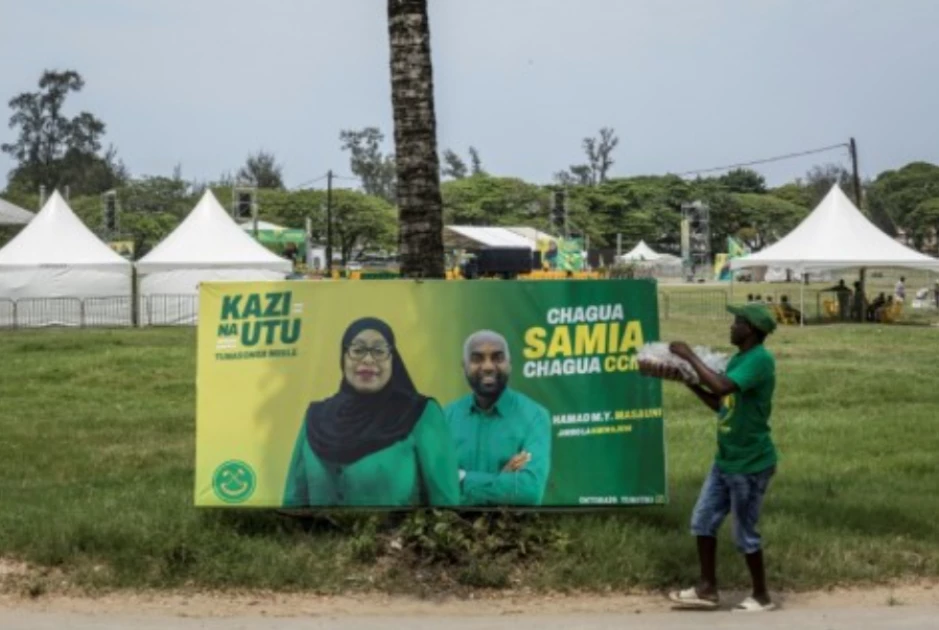
More than 50 billboards bearing the image of Tanzanian President Samia Suluhu Hassan lined the road from Zanzibar’s main airport on Friday as she arrived for her final campaign rally ahead of next week’s general election. The island, known globally for its spices and white sandy beaches, is also the birthplace of President Hassan, affectionately referred to by supporters as “Mama Samia.” Despite her strong political roots on the island, her campaign spared no effort in mobilising support, turning Zanzibar into a sea of the ruling Chama Cha Mapinduzi (CCM) party’s green and yellow colours under the slogan “Work and Humanity.”
The colourful displays stood in sharp contrast to an Amnesty International report released earlier this week that accused Tanzanian authorities of a “wave of terror” and “systematic human rights violations” ahead of the vote. The report said the political climate had become increasingly restrictive, with the opposition facing intimidation, arrests, and limited access to the media.
President Hassan, who took office in 2021 following the death of her predecessor John Pombe Magufuli, is now seeking to cement her hold on power. Initially celebrated for loosening Magufuli-era restrictions and reopening political space, she is today accused by critics of replicating the same tactics of repression once associated with her predecessor.
On Friday, thousands of supporters poured into Stone Town to attend the rally, which was held under tight security. Police officers were stationed at strategic points, while a helicopter hovered above carrying a banner with Hassan’s portrait. Reporters from AFP said they were denied access to the venue despite having accreditation to cover the election event.
When she took to the podium, President Hassan called on Tanzanians to maintain peace and order during the polls. “Let’s go to the ballot with no fear,” she told the cheering crowd, urging citizens to reject violence and embrace unity. Her message came amid growing concerns over possible unrest on the mainland, where opposition groups have accused the government of harassment and voter suppression.
Supporters described the president as a visionary leader who has brought stability and development to the nation. “We see her as a gift from God,” said Mzee Bobea, a trader who wore a CCM shirt and cap. Others echoed the sentiment, insisting that criticism of Hassan stems from gender bias. “They don’t like her because she’s a woman,” said Issam, a tuktuk driver. “But the work she is doing is visible. I support Mama 100 percent.”
However, not everyone shared that enthusiasm. Despite the presence of 17 other presidential candidates, rights organisations say most are symbolic participants, arguing that the election lacks genuine competition. The main opposition party, Chadema, was disqualified after refusing to sign an electoral “code of conduct” unless major reforms were implemented. Its leader, Tundu Lissu, currently faces treason charges — a move critics say is meant to silence dissent.
Many residents in Zanzibar expressed frustration and hopelessness over the political situation. “Who will I elect if all the opposition leaders have been blocked? There is no purpose,” said Suleimani Issa Ali, a businessman. A taxi driver in the city declared that he would abstain from voting altogether, saying, “It’s a waste of time. There is no democracy. It is pure stupidity.” Others complained that Zanzibar remains underdeveloped compared to mainland Tanzania despite years of loyalty to the ruling party.
President Hassan dismissed the criticism and reaffirmed her commitment to national unity, declaring that her government would “protect our unity government with all our strength.” Since forming a union with mainland Tanzania in 1964, Zanzibar has retained its own semi-autonomous government and parliament, though the CCM has never lost an election on the island since its founding in 1977.
Early voting in Zanzibar is expected to begin on Tuesday, ahead of the national polls on Wednesday. While the island’s elections are often described as relatively freer than those on the mainland, they have frequently been marred by violence and allegations of vote rigging.
As the campaign period draws to a close, many residents are simply hoping for peace once the ballots are cast. “We just pray for calm so that life can move on smoothly after the elections,” said Fatuma Mohammed, a trader in Stone Town.