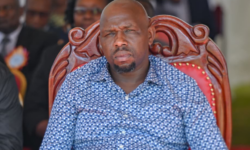
Inspector General of Police Douglas Kanja during a past press address. PHOTO | COURTESY | NPS
Nairobi, Kenya – November 11, 2025
The ongoing tussle over police recruitment has taken a fresh twist after the High Court temporarily halted the hiring of police constables, dealing a major setback to Inspector General of Police Japhet Kanja and the National Police Service (NPS).
Justice Bahati Mwamuye issued conservatory orders suspending the nationwide recruitment exercise that had been set for November 17, 2025, pending the hearing and determination of a petition challenging its legality.
“Pending the inter partes hearing and determination of the Petitioner/Applicant’s Notice of Motion Application dated 06/11/2025, a conservatory order be and is hereby issued suspending the Notice of Recruitment of Police Constables/Officers issued on 04/11/2025 by the 1st Respondent,” reads the order.
The petition was filed by Eliud Matindi, who argues that the Inspector General has no constitutional authority to recruit officers without the involvement of the National Police Service Commission (NPSC) — the body constitutionally empowered to handle all personnel matters within the police service.
According to court documents, the NPSC had earlier announced plans to recruit 10,000 police constables on September 5, 2025, citing its constitutional and statutory mandate. However, that exercise was suspended on October 2, 2025, following a court order in Petition No. E196 of 2025 – Harun Mwau v. Inspector General of Police & Others.
Following that suspension, Inspector General Japhet Kanja issued a new advertisement on November 4, 2025, calling for recruitment across 422 centres countrywide, reigniting a power struggle between the NPSC and the Office of the Inspector General.
The controversy comes just weeks after another High Court ruling that had declared the NPSC’s September recruitment notice unconstitutional, stating that the mandate lay with the National Police Service. Matindi, however, insists that this interpretation is wrong and that the IG acted without lawful delegation from the NPSC as required under Section 10(2) of the National Police Service Commission Act.
“The Inspector General’s decision to recruit without the Commission’s involvement is unconstitutional and an affront to the rule of law,” Matindi’s petition reads.
Justice Mwamuye, while issuing the temporary orders, noted that the case raises substantial constitutional and public interest questions that must be addressed before the recruitment proceeds.
“The issues raised touch on the legality of public appointments and the observance of constitutional boundaries between independent institutions,” the judge observed.
The court has directed the respondents — the Inspector General, the NPS, and the NPSC — to file their responses before the inter partes hearing later this month.
The suspension is a blow to IG Kanja, who had presented the November recruitment as part of his plan to address staff shortages and improve operational readiness within the service. The delay may disrupt the service’s 2025–2026 staffing schedule, especially ahead of the busy festive period and upcoming political events.
The ruling also revives a long-running institutional dispute over who controls recruitment, promotions, and discipline in the police service. Since the adoption of the 2010 Constitution, the Inspector General’s Office and the NPSC have frequently clashed over these powers, leading to repeated court interventions.
Legal analysts say the case could set a precedent in defining the limits of authority between the two bodies, shaping how future police appointments and administrative decisions are handled.
For now, the conservatory orders mean that the planned recruitment of 10,000 constables remains suspended indefinitely, until the constitutional issues raised by the petition are heard and determined.