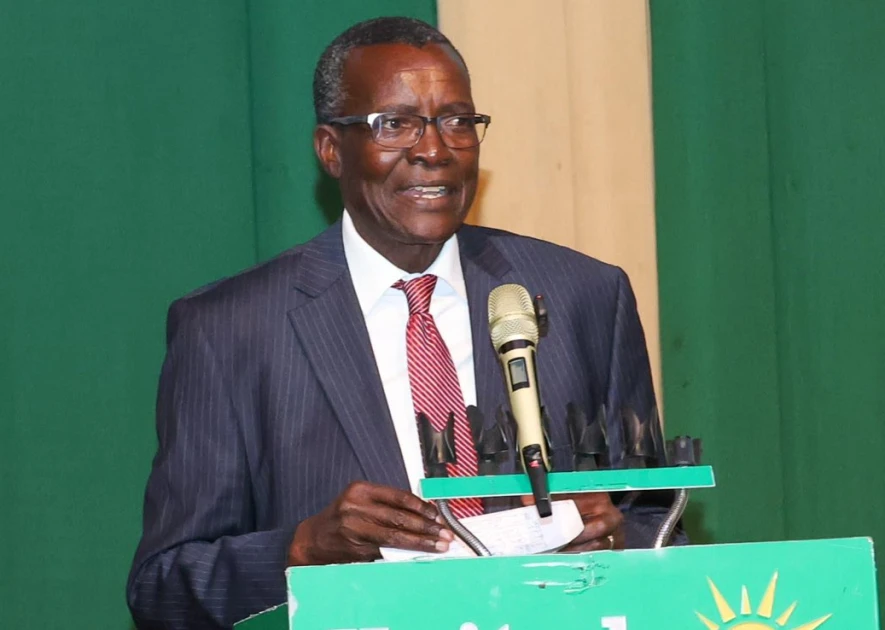
Former Chief Justice David Maraga has called on Kenyans to remain vigilant in protecting the 2010 Constitution, warning that the country risks losing some of the gains achieved through years of struggle for constitutional reform.
Maraga made the remarks as Kenya marked 16 years since the promulgation of the Constitution on August 27, 2010, a day that marked a major turning point in the country’s political and governance history.
In a statement issued to mark the anniversary, Maraga described the Constitution as a product of years of struggle and sacrifice by Kenyans, arguing that it was not a concession from those in power but an expression of the people’s sovereign will.
“Today is a moment of national reflection. Sixteen years ago, Kenyans promulgated a new Constitution. It was not a gift from the powerful, but a hard-fought assertion of our sovereign will, the victory from years of struggle and sacrifice,” Maraga said.
He warned that the achievements associated with the 2010 Constitution could be undermined if citizens fail to defend its principles and hold public institutions accountable.
According to the former Chief Justice, the experience of the past 16 years demonstrates the need for Kenyans to remain actively engaged in protecting constitutional rights and ensuring that state institutions operate within the limits established by the law.
Maraga raises concerns over constitutional rights
Maraga singled out the Bill of Rights and public participation as some of the most important features of the 2010 Constitution.
He argued that these provisions were deliberately included to protect citizens from abuse of state power while ensuring that Kenyans have a meaningful role in decisions affecting the country.
However, Maraga claimed that these safeguards were increasingly being weakened through what he described as superficial implementation and actions that undermine constitutional freedoms.
He cited what he termed the criminalisation of dissent, disregard for court orders and the treatment of public participation as a procedural requirement rather than a constitutional obligation.
The former Chief Justice maintained that public participation should provide citizens with a genuine opportunity to influence government decisions rather than being treated as a formality.
His comments come amid continued public debate over the implementation of the Constitution, the independence of state institutions, the rule of law and the balance of power between different arms of government.
Former Chief Justice criticises Parliament
Maraga also turned his criticism to Parliament, accusing the institution of failing to adequately perform its constitutional oversight role.
He argued that Parliament was established to scrutinise the Executive, question government decisions and restrain executive power where necessary.
However, according to Maraga, the institution has in recent years moved away from robust oversight and towards what he described as acquiescence.
He said the alleged weakening of parliamentary oversight creates room for executive overreach and could contribute to the concentration of power within state institutions.
Maraga further raised concerns over what he described as “state capture”, alleging that public institutions could end up serving narrow interests instead of acting in the interests of citizens.
“When the institutions designed to hold those in power accountable fail, the burden shifts back to citizens, to civil society, to the judiciary, and to every Kenyan because constitutionalism is not self-executing,” he said.
Citizens urged to remain vigilant
Maraga said the responsibility of defending the Constitution should not be left entirely to state institutions.
He argued that citizens, civil society organisations and other institutions have an important role to play in ensuring that constitutional principles are respected.
The former Chief Justice said Kenyans must remain vigilant whenever constitutional rights are threatened or when public institutions fail to perform their mandated roles.
He also emphasised the importance of the judiciary and other accountability institutions in maintaining constitutional governance.
His remarks place particular emphasis on the role of ordinary citizens, who he said must continue to demand accountability from those entrusted with public office.
Maraga links constitutional debate to 2027 election
Maraga also linked the protection of the Constitution to the upcoming 2027 General Election, saying the vote will be about more than choosing political leaders.
According to him, the election will provide Kenyans with an opportunity to decide what type of country they want to build and the kind of governance they expect from their leaders.
“This is why the 2027 elections will be more than a contest between candidates. It will be a referendum on the kind of country we desire,” Maraga said.
He urged Kenyans to approach the 2027 election with the same clarity and courage that he said characterised the struggle that eventually led to the adoption of the 2010 Constitution.
The former Chief Justice warned against what he described as a return to past forms of authoritarian governance, saying Kenyans should carefully consider the political choices they make in the next election.
Maraga is now actively involved in politics and serves as the United Green Movement (UGM) Party co-leader and 2027 presidential flag bearer.
A reminder of the Constitution’s gains
The 2010 Constitution introduced major changes to Kenya’s governance system, including an expanded Bill of Rights, devolution, stronger institutional checks and balances, and greater emphasis on public participation and accountability.
Sixteen years after its promulgation, debates over how fully those provisions have been implemented remain central to Kenya’s political discourse.
For Maraga, the anniversary should therefore not only be a celebration of what Kenyans achieved in 2010 but also an opportunity to examine whether the principles contained in the Constitution are being adequately protected.
“Katiba Day is a reminder of what was won. It must also be a warning about what could still be lost,” Maraga said.
As Kenya heads towards the 2027 General Election, his remarks are likely to add to the growing political debate over constitutionalism, governance, accountability and the protection of democratic institutions.
The former Chief Justice’s message is ultimately a call for Kenyans to remain engaged in the country’s governance and to ensure that the constitutional gains achieved in 2010 continue to guide the country’s political and institutional development.