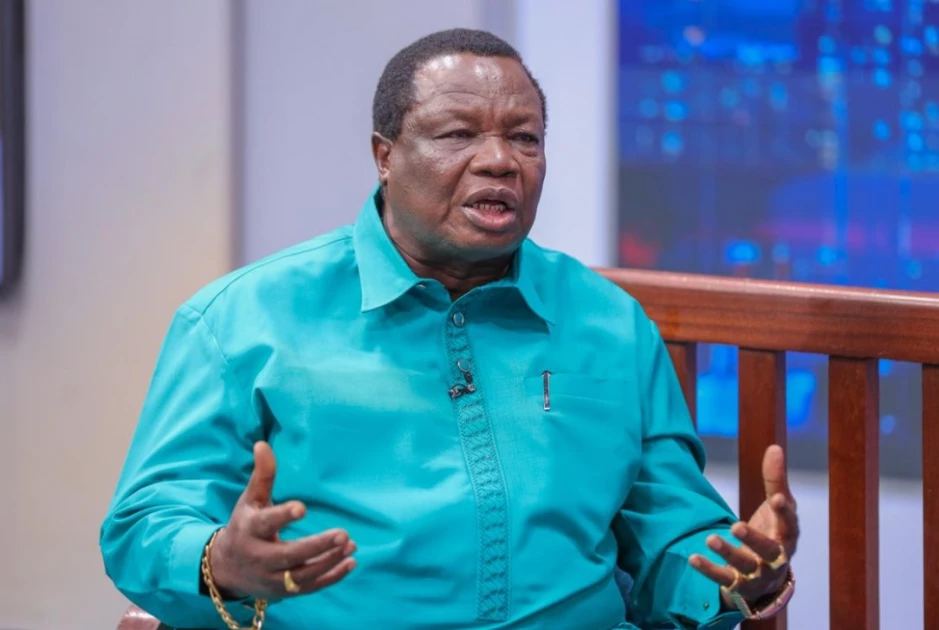
Central Organisation of Trade Unions (COTU) Secretary General Francis Atwoli has cautioned former Deputy President Rigathi Gachagua over his recent claims concerning the procurement of the Integrated Elections Management System (IEMS) by the Independent Electoral and Boundaries Commission (IEBC).
In a statement issued on Thursday, COTU said it had taken serious note of allegations made by Gachagua on Wednesday regarding the electoral commission’s procurement of election technology ahead of the 2027 General Election.
The trade union umbrella body warned that unsubstantiated claims questioning the credibility of the electoral commission could have serious consequences for the country’s political stability and, ultimately, the livelihoods of ordinary Kenyans.
COTU accused Gachagua of relying on what it described as a “proof by assertion fallacy” and cautioned that such statements could contribute to political tensions ahead of the next General Election.
“We wish to caution Rigathi Gachagua against his proof by assertion fallacy that might ultimately plunge this country into violence and thus affect the livelihoods of workers, women and children,” COTU (K) said.
COTU raises concerns over 2027 election
The union expressed concern that continued allegations surrounding the credibility of the electoral process could create doubts about the outcome of the 2027 election before Kenyans even go to the polls.
According to COTU, political leaders have a responsibility to avoid statements that could undermine public confidence in electoral institutions without providing evidence to support the claims.
The union suggested that the continued debate over the IEBC’s procurement process could potentially contribute to an environment in which political actors reject or question the results of the election before the voting process has taken place.
COTU therefore urged political leaders to exercise restraint and allow concerns over electoral procurement to be addressed through established constitutional and legal mechanisms.
Union defends IEBC independence
COTU also invoked Article 249(2) of the Constitution, which provides for the independence of constitutional commissions and independent offices.
The union reminded Gachagua that IEBC is an independent constitutional commission and argued that no individual should dictate how the commission performs its legally mandated functions.
According to COTU, any concerns over the procurement of the IEMS should be presented before the appropriate institutions rather than being addressed through public accusations.
The union said there are established procurement procedures and legal avenues through which individuals and organisations can challenge decisions made by public institutions.
The remarks come as the IEBC faces a challenge over its tender for a new elections management system. The commission has admitted an error in one of the tender requirements but has denied allegations that the procurement process was designed to favour a particular company.
For more details, see IEBC admits error in election system tender, denies favouring South Korean firm.
Atwoli questions Smartmatic preference
COTU also questioned Gachagua’s apparent preference for Smartmatic as an alternative election technology provider.
The union argued that Gachagua’s position appears inconsistent with his criticism of the IEBC procurement process.
COTU said that while Gachagua has accused IEBC of allegedly designing its procurement process around a preferred company, his apparent endorsement of another private technology provider raises similar questions.
“Gachagua must explain to Kenyans why he himself appears to be prescribing another private company as his preferred election technology provider,” COTU said.
The union further called on Gachagua to explain the basis upon which he had concluded that Smartmatic should be the technology provider retained by IEBC.
COTU’s criticism comes amid a wider political debate over the technology Kenya will use to manage elections, including voter identification, results transmission and other components of the electoral process.
COTU warns against electoral tensions
The trade union body said electoral disputes and political tensions can have far-reaching consequences for the country’s economy and the welfare of ordinary citizens.
COTU particularly warned that workers, women and children could bear a significant burden in the event of electoral or ethnic conflict.
The union therefore called on Gachagua and other political leaders to exercise restraint as Kenya approaches the 2027 General Election.
COTU said political leaders should prioritise national stability and avoid statements that could heighten tensions or create unnecessary fear among citizens.
The organisation maintained that legitimate concerns about the IEBC’s procurement processes should be subjected to scrutiny through the appropriate institutions, rather than being settled through political statements.
Debate over election technology continues
The dispute highlights the growing political attention surrounding Kenya’s preparations for the 2027 General Election.
With the election still ahead, questions surrounding electoral technology, procurement, institutional independence and public confidence are expected to remain prominent in the political debate.
The IEBC has maintained that its procurement processes are subject to the law and has defended the requirements contained in its tender documents.
The commission has also rejected allegations that its procurement process was designed to favour a particular company.
As political parties and other stakeholders begin positioning themselves ahead of the 2027 polls, calls for credible, transparent and peaceful elections are likely to intensify.
For COTU, the priority is to ensure that political disagreements over electoral preparations do not escalate into tensions that could threaten peace and disrupt the livelihoods of Kenyans.
The union has consequently urged political leaders to use established legal and institutional channels when raising concerns about electoral processes while allowing independent constitutional bodies to discharge their mandates.