Mulembe Times
Published on: May 07, 2025 08:22 (EAT)
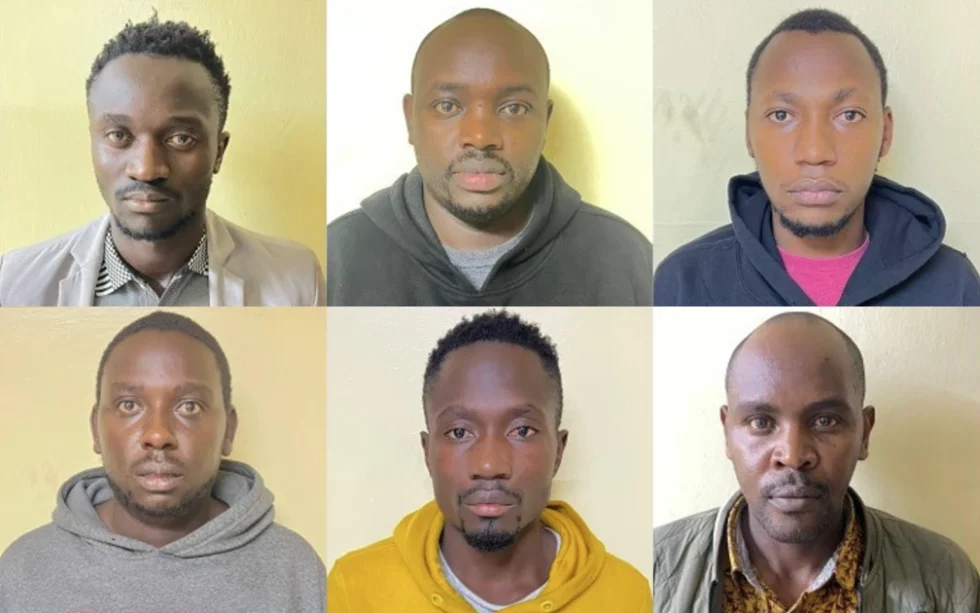
DCI Nairobi arrests six hackers linked to a Ksh.3.2M bank heist using stolen phones and fraudulently registered M-Pesa accounts. Court grants detectives more time to investigate the electronic fraud ring.
A suspected cybercrime syndicate accused of orchestrating a daring Ksh.3.2 million bank theft is now facing justice after being apprehended by detectives in Nairobi. The six suspects, described by authorities as tech-savvy fraudsters, were arrested in a well-coordinated crackdown and arraigned in court following revelations of a sophisticated digital fraud scheme that targeted mobile banking systems.
According to the Directorate of Criminal Investigations (DCI), the arrests followed intense forensic investigations tracing the loss of over Ksh.3.2 million from a victim’s two bank accounts. The operation began in early April and culminated in the suspects being presented before the Makadara Law Courts on different dates.
Three of the suspects — Peter Kariuki Mathii, Isaack Mugo Kanini, and David Nganga Macharia — were arraigned on April 28, while the other three — Fredrick Maina Wairimu, Peter Wandera Ouma, and Hanington Kui Walubengo — were arraigned on Monday, May 5.
DCI reports that the criminal activity began when a motorist was caught in traffic along Nairobi’s Race Course Road. Two individuals approached the vehicle from both sides, pretending it had been involved in a minor road incident. When the driver rolled down his window, one of the suspects snatched the mobile phone from his hand before fleeing the scene.
Using the stolen phone, the syndicate accessed the victim’s mobile banking apps and linked accounts. Within a short period, the criminals had siphoned large sums of money through fraudulently registered M-Pesa accounts, dispersing the stolen funds across multiple receivers to obscure their trail.
From the first bank account, a total of Ksh.1,892,625 was stolen and distributed as follows:
- Ksh.689,500 sent to Fredrick Maina Wairimu,
- Ksh.299,500 to Brian Machani,
- Ksh.499,500 to Brian Obaye Kiveu,
- Ksh.404,125 was laundered through the victim’s own number using encrypted M-Pesa transactions.
The second bank account lost Ksh.1,311,615, with the funds transferred as follows:
- Ksh.299,500 to Bonface Kirim Baimana,
- Ksh.299,500 to John Erick Musyoki Kyengo,
- Ksh.211,000 to Jambo Pay Trust,
- Ksh.501,615 to seven other Safaricom-registered mobile lines.
Detectives revealed that Fredrick Wairimu admitted during interrogation that he had been paid Ksh.1,000 per account to open 11 bank accounts linked to various Safaricom numbers, under instructions from Ouma. This confession led investigators to Walubengo, who allegedly connected Ouma to the wider fraud ring.
DCI’s efforts to dismantle the syndicate also led to the arrest of Peter Mathii and Isaack Kanini, who were found inside a Toyota Voxy in Ruiru. A search of the vehicle uncovered:
- Multiple Safaricom SIM cards,
- A SIM card registration device,
- Counterfeit U.S. dollar notes,
- Several ATM cards.
The breakthrough continued with the capture of David Macharia, the suspected mastermind, who had been wanted since 2019 for similar offences. A search of his Subaru (Reg. No. KDB 879M) and residence in Zimmerman, along Thika Road, revealed:
- Dozens of mobile phones and SIM cards,
- Multiple national ID cards,
- Fake foreign currency,
- Laptops and banking documents.
Macharia had previously been issued an arrest warrant by Milimani Law Courts on January 24, 2019, and was believed to be operating from the shadows of Nairobi’s growing cybercrime underworld.
All six suspects are now in custody as the investigation continues. The courts have granted detectives 10 to 21 days to detain the accused for further inquiries.
Authorities are urging the public to be vigilant with mobile devices and banking apps, as fraudsters are increasingly using both low-tech theft and high-tech digital manipulation to exploit victims.We are following up on the news and we will keep you updated.