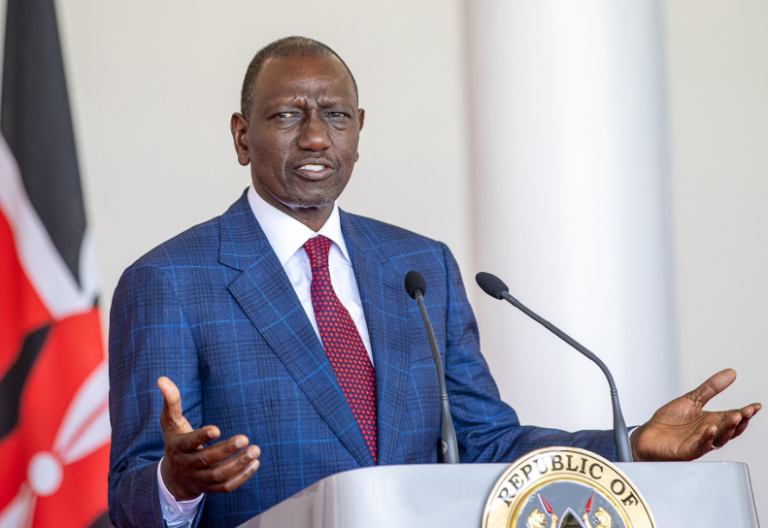
President William Ruto has dismissed claims that Kenya is a failed state, calling on citizens to avoid negativity and focus on the country’s progress.
The President made the remarks in Gikambura, Kikuyu, during the burial of Mzee Isaac Ichung’wah, the father of National Assembly Majority Leader Kimani Ichung’wah. Addressing mourners, Ruto insisted that Kenya remains on the right path and urged unity in nation-building.
“We must stop with the negativity. Kenya is not a failed state. As we move forward, we will do it together, and the country will be greater than it is today,” Ruto said.
The Head of State pointed to agriculture as one area where positive results are visible. He announced that Kenya is on track to record its largest maize harvest in history, projecting about 75 million bags in 2025. This is higher than the 70 million bags forecast by Agriculture Cabinet Secretary Mithika Linturi earlier in the year. Ruto said the bumper harvest is proof that government interventions, such as subsidised fertiliser and support to farmers, are bearing fruit.
Maize output has risen steadily in recent years, from 34.3 million bags in 2022 to 67 million bags in 2024. The Agriculture Ministry has also announced plans to restock the National Strategic Food Reserve by buying grain directly from farmers. Officials say this will not only strengthen food security but also guarantee a stable market for producers.
During his speech, the President also paid tribute to Majority Leader Kimani Ichung’wah, describing him as both a trusted ally and a close personal friend. He praised Ichung’wah for his loyalty and resilience, saying he had “carried burdens that even my brothers could not.”
Ruto’s comments come at a time when his administration faces strong criticism from opposition leaders and sections of the public. Detractors argue that high living costs, unemployment, and rising public debt are signs of weak governance. Some civil society groups have gone as far as to warn that Kenya risks sliding into instability if urgent reforms are not made.
The debate over whether Kenya is a “failed state” has gained traction in political discourse, especially in the wake of anti-government protests earlier this year. Demonstrators accused the government of failing to address economic hardships and claimed state institutions were losing credibility. The opposition has used these grievances to pressure Ruto’s administration, arguing that Kenyans are not experiencing the benefits of development promises.
In response, government officials maintain that the challenges are being addressed and that progress cannot be ignored. They cite achievements in agriculture, infrastructure development, and digital innovation as evidence that Kenya is not only stable but also advancing. Supporters of the administration argue that while economic conditions remain difficult, the government is putting in place long-term policies to create jobs, stabilise prices, and improve service delivery.
Analysts note that the term “failed state” is often politically charged and rarely reflects the full picture. While Kenya faces serious hurdles, it continues to maintain democratic institutions, an active civil society, and steady growth in key sectors. Observers say these strengths set it apart from states that have truly collapsed.
By urging Kenyans to stay positive, President Ruto appeared keen to counter the narrative that his government is losing control. His emphasis on food security, unity, and optimism suggests he wants to rally the public behind his administration despite ongoing criticism.
As the country awaits the results of the expected maize harvest and other government programmes, the debate over Kenya’s economic and political health is likely to remain a central issue. For now, Ruto maintains that Kenya’s future is secure , provided citizens and leaders work together instead of dwelling on negativity.
Image by TV47 Digital