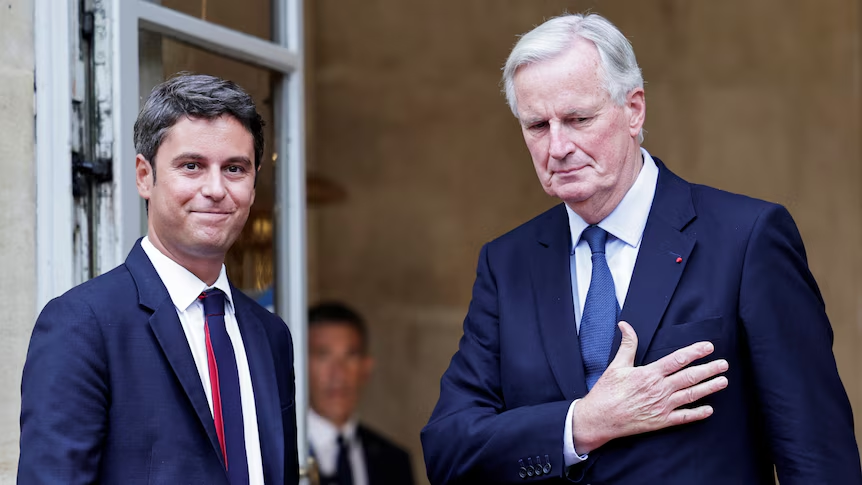
President Emmanuel Macron has announced a new French government under Prime Minister Sébastien Lecornu, marking yet another attempt to stabilize his administration amid growing political uncertainty and deep divisions in parliament. The reshuffle, revealed on Sunday, aims to restore confidence in a government struggling with fiscal challenges, a restless opposition, and public dissatisfaction over the country’s economic direction.
Lecornu’s appointment as prime minister was seen as a strategic move by Macron to strengthen his grip on power while signaling continuity in leadership. Lecornu, who previously served as defense minister, now faces the daunting task of managing a fragile coalition with no clear majority in the National Assembly. His leadership will be tested as France approaches critical debates on public spending, pension reforms, and the 2026 national budget.
The newly unveiled cabinet features both experienced figures and new faces in key ministries. Roland Lescure was appointed finance minister, a role that places him at the center of France’s efforts to manage its rising debt and sustain economic growth. Bruno Le Maire, who had previously held the finance docket, was shifted to defense, a move interpreted as Macron’s attempt to maintain his influence over both the economy and security matters. Other notable appointments include Élisabeth Borne as education minister, Manuel Valls handling overseas territories, Bruno Retailleau taking over the interior ministry, and Gérald Darmanin retaining his position as justice minister.
Despite the changes, the new government is already facing criticism and skepticism from opposition parties. With Macron’s centrist alliance lacking a parliamentary majority, Lecornu’s administration risks immediate confrontation in the legislature. Both left-wing and far-right factions have hinted at the possibility of a no-confidence vote, a move that could force Macron to dissolve parliament or call for early elections — a risky political gamble he has faced before.
The reshuffle comes in the aftermath of Macron’s controversial decision to dissolve the National Assembly in 2024, a move that left France with a fragmented parliament and no dominant coalition. This has complicated the passage of vital reforms and widened the political rift across the country. Lecornu’s challenge will be to forge new alliances while maintaining the president’s reform agenda.
Political analysts suggest that Lecornu’s government may adopt a more conciliatory tone compared to previous administrations. By appointing figures like Lescure, who has a reputation for dialogue, Macron appears to be reaching out to moderate lawmakers, particularly from the left, to build consensus on economic and social policies. However, critics argue that without significant policy changes, this cabinet could merely be a reshuffled version of the old guard, offering little real transformation.
France’s political landscape remains volatile. With rising public concern over inflation, immigration, and the cost of living, Macron’s government must balance fiscal discipline with social stability. Lecornu’s ability to navigate this environment will determine whether the new government can survive or become yet another casualty in the president’s turbulent second term.
For now, the French public watches with cautious optimism , and a fair dose of skepticism ,as Lecornu takes the reins of a nation yearning for political calm and effective leadership. Whether this reshuffle brings renewal or simply delays another crisis remains to be seen.
IMAGE BY ABC NEWS