


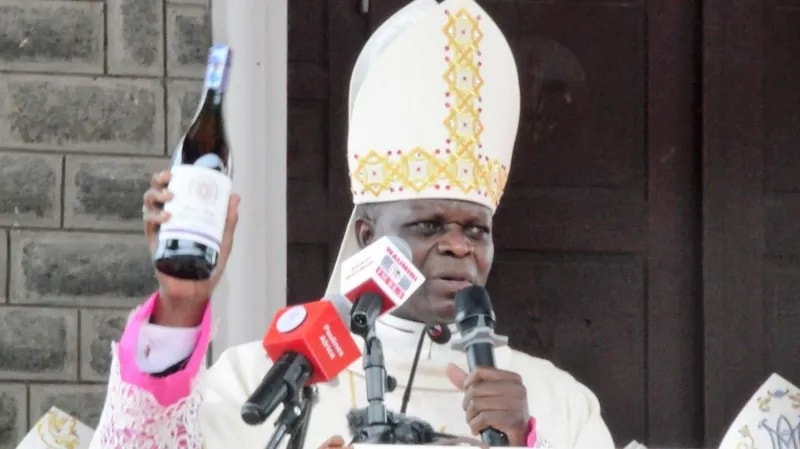
The Catholic Church in Kenya has made a bold decision to stop using its previous altar wine after discovering that it had become widely available in local bars and liquor shops, stripping it of its sacred value. The Kenya Conference of Catholic Bishops (KCCB) announced that a new, exclusive wine will now be used for Holy Communion to preserve the sanctity of the sacrament.
Speaking during the 38th National Prayer Day at the Subukia Shrine in Nakuru County, KCCB Chairman Archbishop Maurice Muhatia Makumba explained that the Church could no longer tolerate the commercialization of a product meant solely for worship. He noted that what was once a sacred element of the Eucharist had turned into an ordinary drink, consumed freely by the public, which was deeply inappropriate.
In response, the bishops introduced a new wine known as Mass Wine, produced by Lutzville Vineyards (RF) (Pty) Limited in South Africa. The wine has been officially approved for liturgical use by the KCCB and meets all canonical requirements—it is made purely from grapes and contains no artificial flavoring or coloring. Each bottle carries the KCCB logo and the signature of the conference chairman, making it distinct from any other wine on the market.
According to Archbishop Makumba, the move is meant to protect the holiness of the Eucharist and remind Catholics that church sacraments should remain sacred and separate from commercial use. “When something used in worship becomes easily available in entertainment joints, it loses its symbolic value and the reverence it deserves,” he said, emphasizing the Church’s responsibility to maintain the spiritual integrity of its rituals.
The new Mass Wine contains 17 percent alcohol—slightly less than the former one, which had 18 percent—and will retail at approximately KSh 1,800 per bottle. The archbishop clarified that while the price difference is small, it reflects the effort to ensure authenticity, quality, and exclusivity in its production and supply.
To prevent misuse, the bishops’ conference has introduced strict distribution guidelines. Every diocese will have a designated procurement officer responsible for purchasing the wine directly from authorized suppliers. Additionally, parishes will no longer be allowed to accept wine as an offertory gift from worshippers, ensuring tighter control and preventing the sacred wine from being diverted to the open market.
The Church has assured faithful Catholics that the transition will be rolled out gradually to ensure every diocese and parish is properly supplied. While some parishioners have raised concerns about distribution challenges in remote areas, the KCCB says plans are in place to ensure a smooth changeover.
Ultimately, the decision represents more than just a switch of brands—it is a spiritual statement. The Church is reasserting that sacred symbols used during Mass must remain holy and untouched by commercialization. Archbishop Makumba reminded believers that the Eucharist is the heart of Catholic worship and must always be treated with the deepest respect and purity.
Image by Smart Eagles


