President signals broader political cooperation as succession politics take shape ahead of 2027 polls
President William Ruto has indicated that forging a political alliance with the Orange Democratic Movement (ODM) is central to his strategy for securing a second term in office, as Kenya’s political landscape continues to realign ahead of the 2027 General Election.
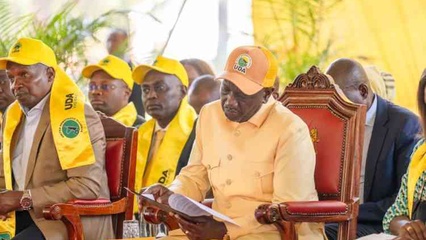
Speaking during a meeting with leaders of the United Democratic Alliance (UDA), Ruto acknowledged that his victory in the 2022 presidential election was narrow and said future electoral success would require a broader and more inclusive political base. He argued that expanding cooperation beyond traditional party lines would help stabilise the country politically while also delivering a stronger mandate from voters.
Ruto noted that building a working relationship with ODM was not merely about winning elections but about fostering unity and enabling smooth governance. He framed the potential coalition as an opportunity to bring together diverse political constituencies and reduce the confrontational politics that have often characterised Kenya’s electoral cycles.
The President said his administration was keen on avoiding a repeat of tightly contested elections that leave the country divided. He maintained that a wider political alliance would give the government room to focus on development priorities without constant political distractions.
The remarks build on the existing cooperation between UDA and ODM, which has seen members of the opposition party take up roles within government and support certain legislative and policy initiatives. This working arrangement has been described by the President as a “broad-based approach” to leadership, aimed at ensuring inclusivity and national cohesion.
Within UDA, party leaders have reportedly endorsed the idea of structured talks with ODM to formalise the partnership ahead of the next election. Supporters of the move say such an alliance could help consolidate support across regions that traditionally vote along party and ethnic lines.
However, the prospect of a UDA–ODM coalition has also generated debate within ODM itself. While some leaders view continued cooperation with the government as a chance to influence policy from within, others believe the party should chart its own independent path in 2027. These internal divisions have sparked discussions about ODM’s long-term identity and electoral strategy.
Political analysts say Ruto’s push for a coalition reflects shifting dynamics following recent changes within the opposition, which have left some voter blocs politically unsettled. They note that alliances are likely to play a critical role in determining the outcome of the next election, particularly as competition intensifies among emerging and established political figures.
Supporters of the coalition idea argue that a UDA–ODM partnership could help stabilise governance and reduce post-election tensions by delivering a decisive outcome at the ballot. They say such cooperation could also provide a stronger platform for addressing economic challenges, job creation, and service delivery.
Critics, however, warn that coalition politics may weaken party identities and fuel internal disputes, especially if power-sharing arrangements are not clearly defined. Some argue that voters may view broad alliances as elite-driven deals that do not necessarily reflect grassroots interests.
As discussions continue, President Ruto has remained confident that cooperation with ODM would enhance national unity and strengthen his re-election prospects. Whether the talks result in a formal coalition or remain a strategic partnership, observers agree that the evolving relationship between UDA and ODM is likely to shape Kenya’s political direction in the run-up to 2027.
Image by Online Kenya