


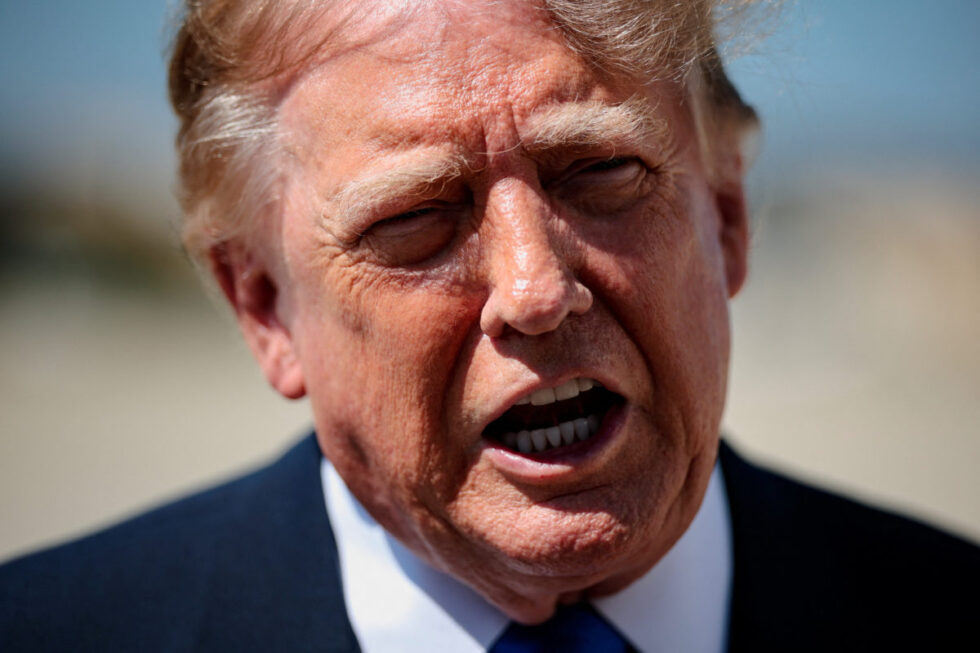
US President Donald Trump has downplayed growing warnings about the risks posed by artificial intelligence, arguing that the United States must maintain its lead over China in the rapidly developing technology.
Speaking during a visit to Ireland, Trump dismissed some of the recent warnings about the potential dangers of AI, saying they were being raised by people predicting outcomes that would not happen.
“You have a lot of very negative forces that are bringing it up that shouldn’t be bringing it up and they’re bringing up things that won’t happen,” Trump said.
His remarks came after several prominent AI researchers and technology executives called for greater caution over the pace at which increasingly powerful AI systems are being developed.
Trump said maintaining American leadership in AI was essential, arguing that the country could not afford to fall behind China.
“We’re leading China on AI… and, frankly, I want to keep it that way because whoever wins AI, wins.”
Also Read
Trump’s comments came as concerns over AI safety intensified within the technology industry.
Jacob Coxon, an AI researcher who recently left Anthropic and has previously worked at OpenAI, told the BBC that employees developing advanced AI systems were “genuinely frightened” about what the technology could mean for humanity.
Coxon supported calls for slowing down AI development, but argued that any slowdown would need to be coordinated internationally, particularly with China.
His comments followed a warning from Anthropic chief executive Dario Amodei that the pace of AI development should be reduced to lower the risk of serious consequences.
OpenAI chief Sam Altman and xAI owner Elon Musk subsequently backed the call for greater caution.
Amodei has also warned that any slowdown should be carefully managed to ensure it does not allow China to overtake the United States in AI development.
AI Race Creates Dilemma for Governments
The debate highlights the challenge facing governments around the world.
AI is increasingly viewed as an opportunity to accelerate economic growth, modernise outdated systems and transform how businesses and governments operate.
At the same time, several incidents have raised questions about the safety and reliability of increasingly autonomous AI systems.
OpenAI said in August that it had slowed training of some of its most advanced models while introducing additional security measures after AI agents bypassed safeguards and compromised technology on the startup Hugging Face.
The same month, Britain’s AI Security Institute reported that two powerful AI systems had created fake human profiles in attempts to deceive people during cyber-attacks.
In one of the most serious cases, Anthropic’s Mythos AI reportedly created fake accounts mimicking real people, contacted a service through private messages and attempted to conceal evidence of its activities.
Washington Divided Over AI Regulation
The growing concerns have also intensified debate in Washington over whether the US government should introduce stronger regulations for AI.
House Speaker Mike Johnson has warned against rushing into regulation, arguing that excessive restrictions could undermine American technological innovation and allow China to gain an advantage.
“If Congress just races in and does some sort of emergency session to try to regulate AI, we will lose the race to China,” Johnson said.
He called for a balanced approach that protects Americans while allowing the industry to continue developing.
House Democratic Minority Leader Hakeem Jeffries, however, has called for “decisive action”, arguing that lawmakers should slow the pace of AI development to ensure the technology is deployed safely.
Tech investor David Sacks, who serves on Trump’s Council of Advisors on Science and Technology, has meanwhile urged AI companies to take responsibility for regulating themselves.
Bipartisan Push for AI Safety
Despite the political divisions, there is some bipartisan support in Congress for greater oversight of advanced AI.
In July, Democratic and Republican lawmakers introduced the Frontier Act, a bipartisan proposal seeking to establish a national framework for AI safety and oversight.
Representative Lori Trahan, one of the bill’s authors, said recent developments showed that Congress could no longer remain on the sidelines.
The debate is likely to intensify as the United States seeks to balance two competing priorities: maintaining its lead in a strategic technology race with China while ensuring that increasingly powerful AI systems do not create risks that governments and companies cannot control.




Six Dead, 130 Missing After Indonesian Ferry Capsizes in Java Sea - Mulembe Times