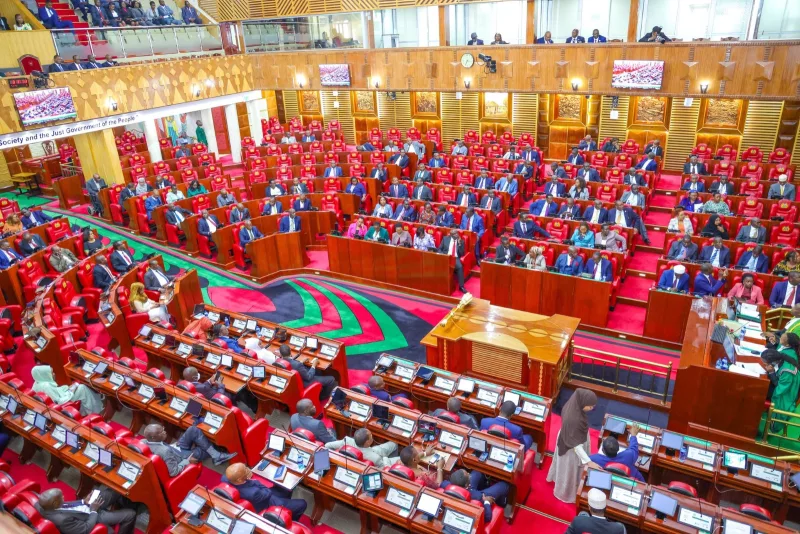
The State Department for Parliamentary Affairs has clarified that the Elections (Amendment) (No. 2) Bill, 2024, retains the requirement for the Independent Electoral and Boundaries Commission (IEBC) to establish a mechanism for livestreaming election results ahead of the 2027 General Election.
In a statement issued on Saturday, Parliamentary Affairs Principal Secretary Dr. Aurelia Rono dismissed reports claiming that amendments passed by the National Assembly had removed the livestreaming requirement.
Rono said the House had deleted a clause seeking to amend Section 39 of the Elections Act, which governs the determination and declaration of election results.
“Contrary to these reports, the amendment passed by the National Assembly retains the requirement on the IEBC to establish a mechanism for the livestreaming of election results,” Rono said.
The clarification follows the passage of the Bill by the National Assembly on Thursday, October 22, 2026, after its consideration by the Departmental Committee on Justice and Legal Affairs, which undertook public participation and engaged stakeholders, including the IEBC.
According to Rono, Clause 22 of the Bill, as received from the Senate, proposed deleting Section 39 of the Elections Act and replacing it with a different provision.
However, the National Assembly deleted the clause following a High Court judgment delivered on September 22, 2026, which upheld the constitutionality of Section 39 and Regulation 83(2) of the Elections (General) Regulations.
In the case of Okoiti & another v Independent Electoral and Boundaries Commission & 5 others, the court declined a request by petitioners to invalidate the two provisions. It also urged Parliament to consider its interpretation of Section 39 when finalising electoral legislation ahead of the 2027 polls.
Rono said the National Assembly had consequently retained Section 39 in its existing form, including the livestreaming requirement under Section 39(1G).
“Cognisant of the guidance of the High Court, the National Assembly deleted Clause 22 to ensure the retention of Section 39 as it is currently provided for in the Elections Act and also retained the requirement for livestreaming as provided for under Section 39(1G),” she said.
Other Proposed Changes to Electoral Laws
Beyond the livestreaming provision, the Bill proposes several changes to Kenya’s electoral framework.
These include requirements for the voters’ register to be available for inspection, except during specified periods before an election or referendum.
The proposed legislation also seeks to remove the IEBC’s involvement in political party primaries, revise the procedure for recalling Members of Parliament to align with the Constitution, and give political parties greater flexibility in identifying and nominating candidates for elective and party-list positions.
Additionally, the Bill proposes suspending voter registration during a by-election only within the affected electoral area. A person registering during the suspension would not be eligible to contest in that particular by-election.
The proposed law also seeks to promote fairness, accountability and substantive justice in the hearing and determination of electoral disputes.
Bill Returns to Senate
Following its passage by the National Assembly with amendments, the Bill will be returned to the Senate for consideration in accordance with Article 110(4) of the Constitution.
The next stage will determine the legislative progress of the proposed amendments as Kenya prepares for the 2027 General Election.
Rono urged Kenyans to rely on official sources when seeking information about legislative proposals and to verify reports before sharing them, amid public debate over the proposed changes to the country’s electoral laws.