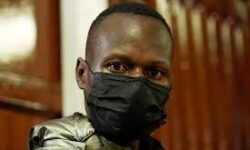
Political activist Nuru Okanga has been acquitted of all charges after a Nairobi court ruled that the prosecution failed to establish a prima facie case linking him to alleged threatening social media content targeting President William Ruto.
In a ruling delivered on Tuesday morning, the court found that prosecutors did not present sufficient or credible evidence to prove that Okanga authored, uploaded, or disseminated the video that formed the basis of the charges.
Okanga had been charged with publishing false, defamatory and threatening information on social media platforms, including TikTok. The prosecution alleged that the video contained remarks urging the then Deputy President to use his past experience as a District Commissioner to shoot the Head of State.
However, the court identified serious gaps and inconsistencies in the prosecution’s case, particularly in the handling and authentication of electronic evidence.
Failure to Link Okanga to the Video
In its determination, the court noted that the prosecution failed to demonstrate any direct connection between Okanga and the alleged video clip. A digital analyst who testified admitted under cross-examination that the video was not extracted from Okanga’s electronic devices.
The analyst further conceded that the digital forensic tools used in the analysis had emerging errors, raising serious concerns about the reliability and integrity of the findings.
A key prosecution witness also told the court that he could not authenticate the video or confirm that it originated from the accused person’s social media accounts.
“The prosecution has not demonstrated how the accused person authored, published, or uploaded the alleged content,” the magistrate ruled.
Breach of Rules on Electronic Evidence
The court further faulted the prosecution for failing to comply with the legal requirements governing the handling of electronic evidence.
It found that investigators did not demonstrate that the relevant telecommunication devices were properly tendered, preserved, or extracted in accordance with the law. The prosecution also failed to establish a clear chain of custody, as required under Section 106 of the Evidence Act.
Additionally, the court observed that the extraction and analysis process of the alleged digital material was not adequately explained or documented, further weakening the prosecution’s case.
Investigating Officer’s Admission Raises Doubts
During the hearing, the investigating officer admitted that he was not a digital forensic expert and could not determine whether the video was authentic or potentially AI-generated.
He also told the court that he relied entirely on a report from the Communications Authority of Kenya (CA) to proceed with the charges and did not personally play or analyse the video in court.
The officer further acknowledged that Okanga is a known political activist but could not conclusively determine whether the alleged remarks constituted a criminal threat or amounted to political opinion protected under the law.
Court Finds No Case to Answer
After reviewing the evidence, the magistrate ruled that the prosecution had failed to meet the legal threshold required at the close of its case.
“This court finds that the prosecution has not demonstrated a prima facie case against the accused person in all three counts,” the magistrate stated.
Consequently, the court acquitted Okanga of all charges under Section 210 of the Criminal Procedure Code, holding that he had no case to answer.
Babu Owino Hails Verdict as Victory for Justice
Okanga was represented by Embakasi East Member of Parliament and advocate Babu Owino, who welcomed the ruling, describing it as a major victory for justice and due process.
“Today, justice spoke. After a long and exhausting year in court, Nuru Okanga walked free when the Honourable Magistrate ruled that the prosecution failed to present sufficient evidence,” Owino said.
“This is more than a legal victory. It is the saving of a life — one man rescued from the jaws of prison.”
The lawmaker also praised the defence team for its persistence, saying the acquittal reaffirmed the importance of evidence-based prosecutions and constitutional safeguards.
“We celebrate this hard-fought triumph with deep gratitude to the dedicated counsel whose tireless defence, commitment, and belief in justice made this moment possible. Today, hope prevailed,” he added.
Broader Implications
The ruling underscores growing judicial scrutiny over the use of digital and social media evidence, particularly in politically sensitive cases. It also raises fresh questions about investigative standards, forensic capacity, and the balance between national security concerns and freedom of expression.
For Okanga, the decision brings an end to a case that has dragged on for more than a year, restoring his freedom after the court found the prosecution’s case fundamentally flawed.