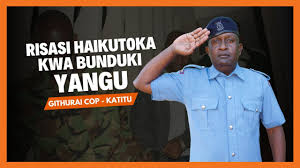
After 8 years behind bars, former cop Titus ‘Katitu’ Ngamau insists he was wrongly jailed. His claims, backed by ballistics evidence, are reviving public debate.
Former police officer Titus Ngamau, popularly known as Katitu, has broken his silence after serving eight years in prison for the killing of a suspected criminal in Githurai. In an emotional interview, the ex-cop has insisted he was wrongly convicted and says he will go to his grave maintaining his innocence.
“I never shot the suspect,” Katitu told Citizen Digital in a tell-all interview following his release. “According to the ballistic report, the bullet that was retrieved from the body of the suspect did not come from my gun.”
Katitu was arrested in 2013 in connection with the fatal shooting of 23-year-old Kenneth Kimani, a suspected gang member operating in Githurai. His arrest and subsequent prosecution sparked a massive public outcry, with week-long protests erupting in the densely populated estate as residents rallied in his defense.
“He Protected Us,” Say Githurai Residents
To many in Githurai, Katitu was not just a police officer — he was a community protector and hero. Known for his aggressive crackdown on gang activity and violent crime, the officer had earned a loyal following in the community, especially among families plagued by insecurity.
“He deserved a medal, not jail,” said one resident who participated in the protests back in 2013. “We were finally starting to live in peace because of him. Then the system betrayed him.”
Residents blocked roads, lit bonfires, and held rallies demanding his immediate release, saying he was being punished for doing the job that other officers feared to do. But their pleas fell on deaf ears. Katitu was formally charged and convicted, later disappearing from public view as he began his prison sentence.
Life in Prison: “It Was Hell”
Now a free man, Katitu is candid about the emotional and psychological toll prison took on him.
“Prison is not a good place,” he reflected. “You’re cut off from your family. You don’t eat what you want. You don’t do what you want. You’re not even allowed conjugal rights.”
As a former police officer in a correctional facility filled with convicted criminals — some of whom he may have helped put behind bars — Katitu says he spent much of his time in isolation for his own safety.
“My movements and interactions were restricted. I was kept apart from the general prison population,” he said. “I was only allowed to make one 2-minute phone call a month.”
Despite the hardship, he says what hurt the most was the separation from his loved ones. “You see them only through a wire mesh. That alone breaks your spirit,” he added.
“I Was Falsely Jailed”
Katitu’s consistent claim of innocence is now being revisited in the court of public opinion. He points to the ballistic evidence as proof that the wrong man was convicted.
“The report was clear. The bullet that killed the suspect didn’t come from my firearm,” he emphasized. “I will leave this world knowing that I was falsely jailed.”
Supporters are now calling for a review of his case and possible compensation for wrongful imprisonment. Legal analysts, however, note that overturning a conviction post-sentence is difficult, even with new evidence, unless a formal appeal is filed.
What Next for Katitu?
Before joining the police service, Katitu was a musician — a talent he now hopes to revive as he reintegrates into society.
“I want to start over, live in peace, and maybe return to music. I’ve lost eight years, but I’ve not lost myself,” he said.
As debates continue over the balance between justice and law enforcement, Katitu’s story has reignited national discussions on police accountability, community policing, and the dangers of trial by public opinion.
For now, he walks free — but not without scars.