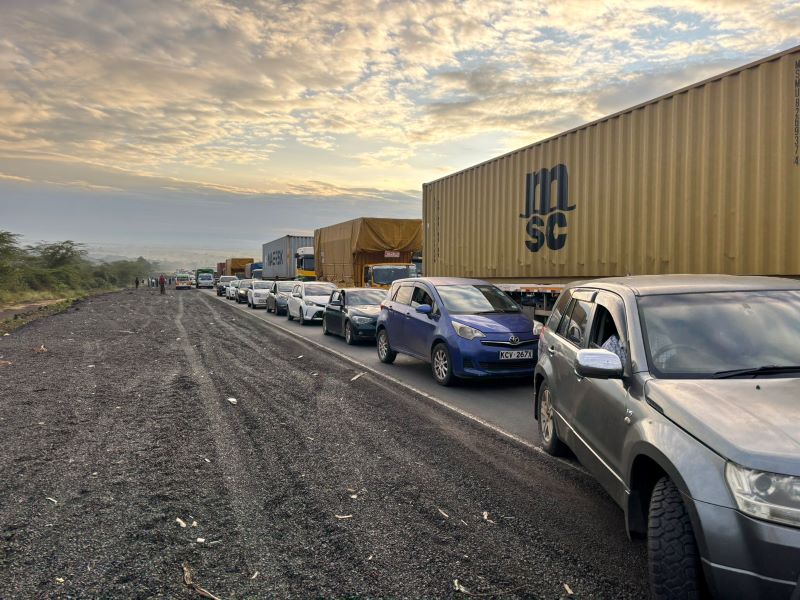
Motorists and transporters were stranded for hours this week along the Nakuru–Eldoret Highway, with a two-day traffic jam reported around Salgaa, a notorious bottleneck that has long frustrated road users.
The gridlock has drawn sharp criticism from the Motorists Association of Kenya (MAK), which accused government agencies of “deliberate failure” in addressing chronic congestion and stalled infrastructure projects.
In a strongly worded statement, MAK said the chaos was “not an accident of circumstance but a stage-managed breakdown” engineered to justify the government’s shift toward Public-Private Partnerships (PPPs) in road management.
“The chaos on the Nakuru–Eldoret Highway and the two-day traffic snarl-ups at Salgaa and Rironi are not misfortunes; they are symptoms of an engineered neglect meant to justify private profiteering under the guise of PPPs,”
said MAK.
The association blamed the Kenya National Highways Authority (KeNHA) and the Ministry of Roads for failing to complete the dualing of the Nakuru–Sachangwan section, a project that has stalled for years despite heavy public investment.
MAK also questioned the government’s commitment to public infrastructure, citing idle construction machinery, slow progress, and poor coordination as key reasons for worsening congestion on the busy corridor.
At the heart of the association’s anger is the fear that PPPs could transfer control of public roads to private investors, forcing motorists to pay tolls even after decades of contributing to the Road Maintenance Levy Fund (RMLF).
Currently, motorists pay Sh25 per litre in fuel levies, while long-haul truckers face transit fees as high as Sh20,000 per trip. MAK estimates that a single trailer consumes fuel worth around Sh300,000 on a one-way journey — with about half of that amount going to the government through taxes.
“Taxes meant for road development have been collected faithfully, yet instead of reinvesting them into road expansion and maintenance, the government is preparing to reintroduce tolls — a system that was outlawed in 1994 and replaced by the fuel levy,” the group noted.
MAK further argued that the reintroduction of tolls through PPPs amounts to “Private Profiteering Partnerships,” warning that the move would burden road users already grappling with high transport costs.
The association has called on the government to prioritize public investment in road construction and maintenance rather than shifting responsibility to private entities.