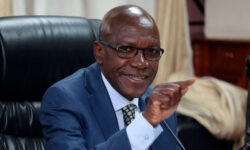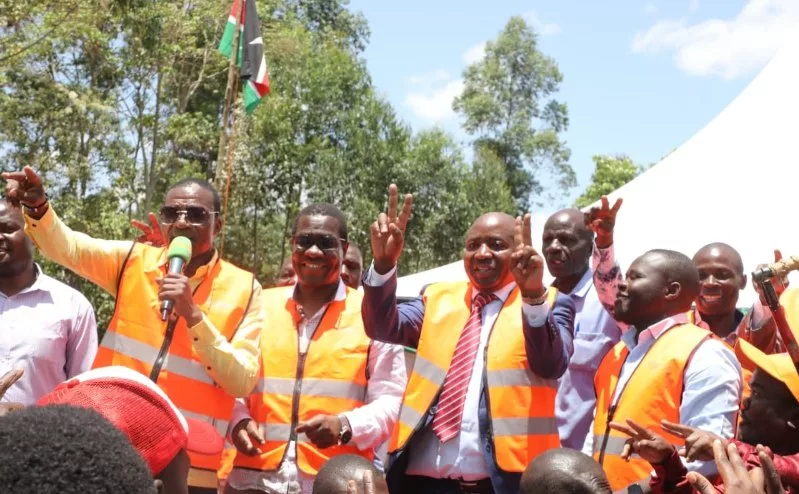
Malava MP David Ndakwa, Energy and Petroleum Cabinet Secretary Opiyo Wandayi, Kakamega deputy governor Ayub Savula, Migori senator Eddy Oketch at Malava constituency during last mile connectivity of electricity
Leaders from Western Kenya and Nyanza are pushing for a political alliance that they say could consolidate more than seven million votes behind President William Ruto in the 2027 General Election.
Led by Energy and Petroleum Cabinet Secretary Opiyo Wandayi and Kakamega Deputy Governor Ayub Savula, the leaders are advocating for political unity between the Luhya and Luo communities.
The proposed realignment would seek to shift two traditionally influential voting blocs, which have historically been associated with former Prime Minister Raila Odinga, towards Ruto.
Speaking during political mobilisation activities in Kakamega and Bungoma counties, the leaders argued that Western and Nyanza could wield significant political influence if their voters united behind a common political strategy.
Savula urged leaders from the two regions to begin laying the groundwork for a joint political arrangement that would extend beyond the 2027 election.
“The two regions should rally behind Ruto in recognition of his administration’s development record,” Savula said.
Savula serves as deputy coordinator of President Ruto’s Western regional campaign lobby.
Sugar revival takes centre stage
Savula cited the revival of major sugar factories as evidence of the government’s commitment to Western Kenya.
He blamed the previous administration for the decline of major sugar industries in the region, arguing that efforts to revive Mumias Sugar and Nzoia Sugar represented a change in government policy under Ruto.
Migori Senator Eddy Oketch also backed the proposed political realignment.
Oketch said the Luo and Luhya communities had previously demonstrated their ability to vote together behind Raila and argued that the same political unity could now be transferred to Ruto.
He described Ruto as the candidate of the broad-based government and said the two communities should use the proposed alliance to position themselves for the 2032 succession.
“The Luo and Luhya communities will negotiate and agree on a joint presidential candidate for 2032 after Ruto completes his second term,” Oketch said.
Wandayi pitches Ruto’s record
Wandayi criticised former President Uhuru Kenyatta’s administration, accusing it of doing little to address economic challenges affecting the wider Lake Region.
He pointed to the revival of Mumias Sugar and Nzoia Sugar as evidence of the Ruto administration’s commitment to Western and Nyanza.
“In the last four years, Ruto has done a lot for the people of Nyanza and Western, and they should reciprocate by giving him all the votes,” Wandayi said.
The proposed alliance would mark a significant shift in Kenya’s electoral arithmetic.
Western Kenya and Nyanza have historically been important battlegrounds in presidential elections, with their voting patterns often influencing the outcome of national contests.
MPs rally behind Ruto
Several leaders from Western Kenya attended the mobilisation events, including Western Parliamentary Caucus chairman John Waluke of Sirisia, Kaikai Bisau of Kiminini, Mary Emase of Teso South, Beatrice Adagala of Vihiga, Dan Wanyama of Webuye West, David Ndakwa of Malava, Fred Ikana of Shinyalu, Lilian Siyoi of Trans Nzoia and nominated Senator Connie Wakwabubi.
Waluke said a majority of MPs from the region were likely to support Ruto, citing development projects initiated by the President across the country.
However, the proposed Western-Nyanza arrangement remains a political mobilisation initiative rather than a formal alliance.
Its ambition is nonetheless significant: to bring together two of Kenya’s major voting blocs, secure their support for Ruto in 2027 and strengthen the bargaining position of Western and Nyanza leaders ahead of the political succession after the election.
What the alliance means for 2027
The proposed Western-Nyanza alliance signals an attempt to rewrite Kenya’s 2027 electoral arithmetic by shifting traditionally Raila-aligned voting blocs towards Ruto.
Beyond securing votes for the President, the initiative points to a potentially larger political bargain—using a united Luhya-Luo voting bloc to strengthen the regions’ negotiating power ahead of the 2032 succession.
Its success, however, is far from guaranteed.
Political endorsements by regional leaders do not necessarily translate into uniform voting patterns at the grassroots. The proposed realignment will have to overcome longstanding political loyalties, local political interests and competition among leaders within the two regions.
Ultimately, the strength of the proposed alliance will depend on whether voters embrace the new political direction and whether its leaders can demonstrate that the arrangement delivers tangible benefits beyond electoral promises.
For now, the message from the leaders is clear: Western and Nyanza should move from being individual political constituencies to becoming a united bargaining bloc in Kenya’s next political contest.