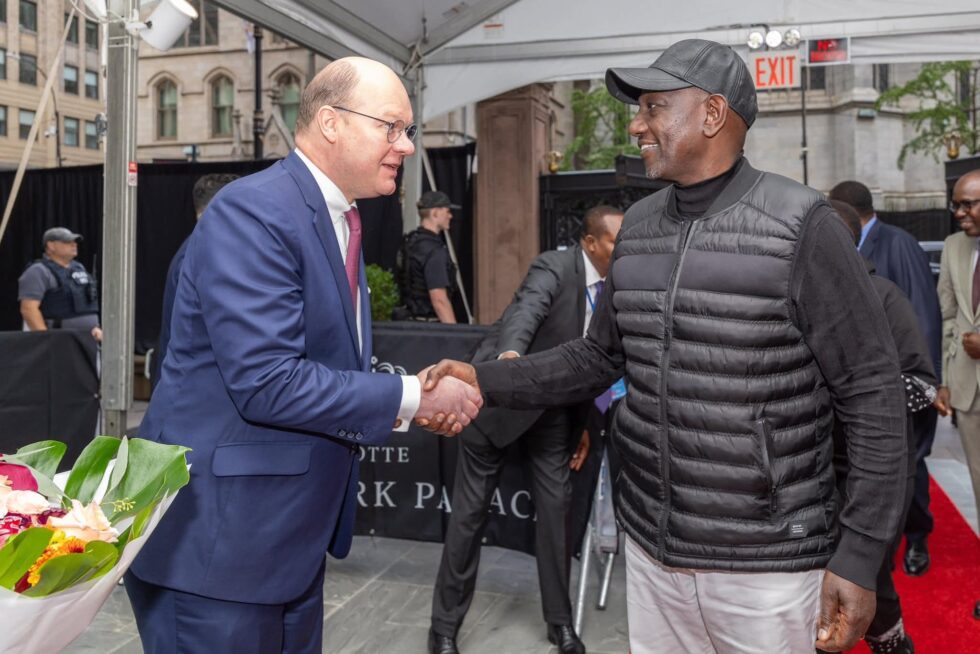
President William Ruto has turned his attention to Kenya’s creative sector, holding talks with U.S. filmmakers and industry leaders in a bid to open up new opportunities for local talent. The discussions are part of his wider agenda at the 80th United Nations General Assembly in New York, where he is championing Kenya’s economic and cultural interests.
On September 25, President Ruto is expected to participate in a high-level roundtable convened by the U.S.-Africa Business Center of the U.S. Chamber of Commerce and AmCham Kenya. The meeting will bring together Hollywood filmmakers, television producers, studio and streaming executives, as well as leaders from the music, sports, and broader creative industries.
The objective of the engagement is to create a strong production pipeline between Kenya and Hollywood, paving the way for partnerships that can expand job opportunities, strengthen small businesses, and drive economic growth in the creative space. According to State House, the creative industry has been identified as one of Kenya’s most promising sectors for youth employment, but remains underdeveloped due to limited investment and global exposure.
One of the projects to be showcased during the talks is The Mara, a film being championed by U.S. filmmaker Evette Vargas of Indigo Reign Films. The project is expected to serve as a case study of how global collaborations can elevate Kenya’s film industry while highlighting the country’s natural heritage and cultural richness. Officials believe such partnerships could attract international productions, turning Kenya into a hub for filmmaking in Africa.
Analysts say Kenya stands to benefit in multiple ways if the talks bear fruit. Increased film and television production in the country would not only create direct jobs for actors, directors, and producers, but also stimulate growth in related sectors such as tourism, transport, hospitality, and fashion. A thriving creative industry could also help position Kenya as a cultural leader in Africa, projecting its stories to global audiences.
However, challenges remain. Industry insiders note that while Kenya has enormous talent, infrastructure and financing for large-scale productions are often inadequate. Piracy and weak copyright enforcement also continue to discourage investment. The government has pledged to address these gaps, but progress has been slow. Ruto’s move to directly engage Hollywood stakeholders is being seen as a bold attempt to bridge these gaps by attracting external funding, skills, and technology transfer.
Beyond the creative economy, President Ruto’s U.N. agenda includes pushing for reforms in the global financial system to ensure fairer access to development financing for poorer nations. He is also expected to renew calls for a more inclusive United Nations, one that better represents the interests of Africa and other developing regions. On peace and security, he will contribute to discussions on ongoing conflicts in Sudan, South Sudan, the Democratic Republic of Congo, Somalia, and Haiti.
For now, the focus remains on how his talks with U.S. filmmakers will translate into tangible gains for Kenya’s creative economy. If successful, the initiative could mark a turning point for an industry that has long been hailed for its potential but has yet to receive the international attention it deserves.
Image From File of President Ruto Facebook