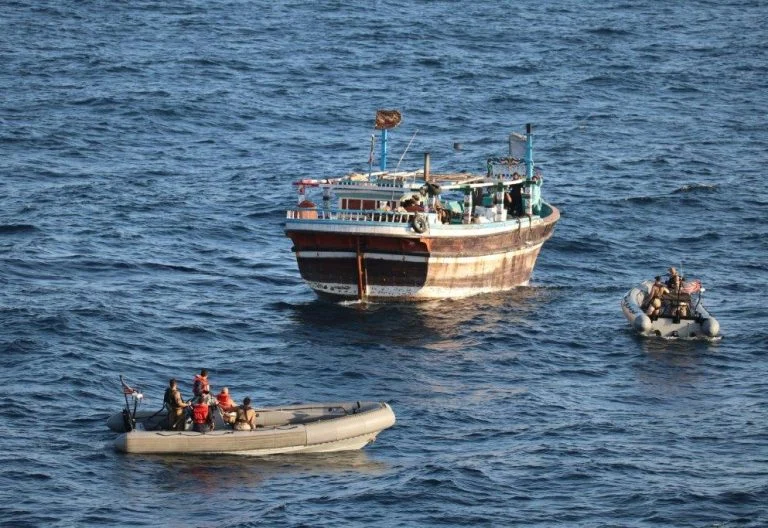
USS Nitze conducts a maritime operation in the Gulf of Aden. PHOTO/@USNavy/X
Somalia has warned of a renewed piracy threat along its northeastern coast after a series of attacks and vessel seizures raised fresh concerns over the safety of commercial shipping and seafarers using the Gulf of Aden.
The Federal Government of Somalia on Sunday called for the immediate and unconditional release of seafarers still being held by pirates, while urging international partners to coordinate maritime security efforts through Mogadishu.
In a statement issued by the Ministry of Foreign Affairs on September 6, 2026, the government condemned what it described as a resurgence of piracy off Somalia’s northeastern coast.
“Somalia condemns in the strongest terms the resurgence of piracy off Somalia’s northeastern coast,” the ministry said.
The government said commercial vessels had been attacked or seized since April, with pirate networks expanding their operations towards the strategic Gulf of Aden.
The resurgence has raised concerns over the security of one of the world’s important maritime corridors, which links the Indian Ocean with the Red Sea and the Suez Canal.
More than 90 seafarers held
The International Maritime Organization (IMO) said in August that more than 90 seafarers were being held captive following an increase in piracy and armed robbery incidents in the Gulf of Aden and surrounding waters.
In July, the IMO called for the urgent release of 44 seafarers held aboard three vessels seized between April and May.
The vessels included MT Honour 25, Eureka and Sward.
The IMO said 24 attempted and actual incidents of piracy and armed robbery had been recorded in the Red Sea and Gulf of Aden region during the preceding three months.
Somalia launches anti-piracy operations
The Somali government said its security forces were taking action against piracy networks both on land and at sea.
Mogadishu pointed to an operation on August 29 that resulted in the release of the Cameroon-flagged cargo vessel MV LUTUF, which pirates had seized off Puntland on August 17.
Somalia said the operation was part of broader efforts to dismantle piracy networks and prevent its waters from becoming a base for maritime crime.
The Somali Defence Ministry had previously claimed that Turkish and Somali forces freed the vessel after a 10-day operation.
According to the ministry, four boats allegedly used by the pirates were destroyed and 14 suspected pirates were killed during the operation.
Puntland disputes government account
The circumstances surrounding the release of MV LUTUF have, however, become a source of dispute.
Puntland authorities rejected the Federal Government’s account of the operation and alleged that a ransom had been paid to secure the vessel’s release.
The ransom allegations have not been independently established.
The dispute highlights continuing tensions between Somalia’s federal authorities and Puntland over security operations and control of maritime affairs.
Mogadishu calls for coordinated security efforts
The Federal Government also stressed that international maritime security cooperation in Somalia should be conducted through the federal government and coordinated with federal member states.
“Partners are welcome to support Somali maritime forces through that framework,” the ministry said.
Somalia further linked maritime security to the protection of its marine resources, arguing that illegal, unreported and unregulated fishing violates the country’s sovereign rights under the United Nations Convention on the Law of the Sea (UNCLOS).
The government also cited Article 100 of UNCLOS, which calls on countries to cooperate in suppressing piracy.
Somalia to raise issue at UN Security Council
Somalia said it intends to raise the renewed piracy threat at the United Nations Security Council, where it currently serves as a member.
The government said it would work with regional and international partners to strengthen efforts against piracy and other forms of maritime crime.
It also pointed to the Djibouti Code of Conduct and its Jeddah Amendment as important mechanisms for regional cooperation.
The latest developments come years after international naval patrols and improved security measures helped bring Somali piracy under control.
The resurgence has now renewed concerns among the international shipping industry over vessels and crews travelling through the Gulf of Aden.
Somalia said it would continue operations against piracy networks and would not allow its waters to become a haven for maritime crime.