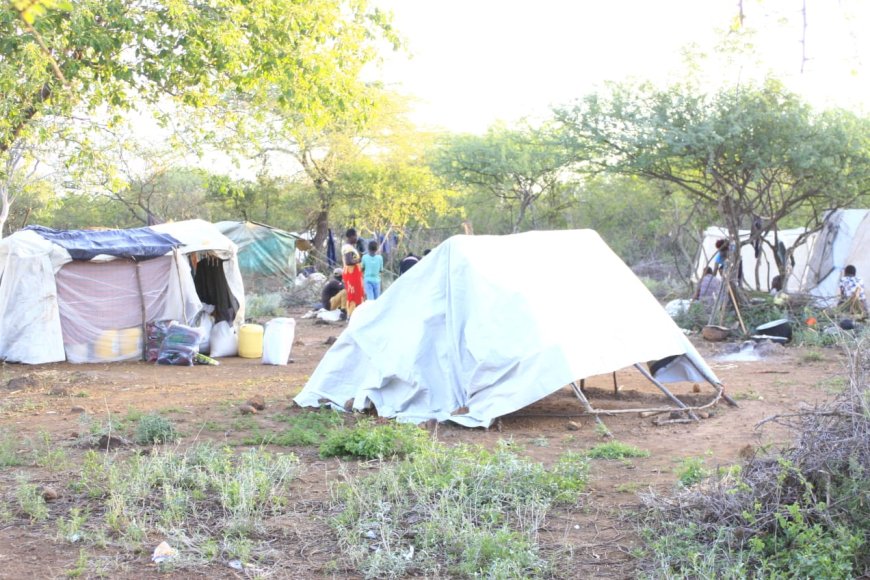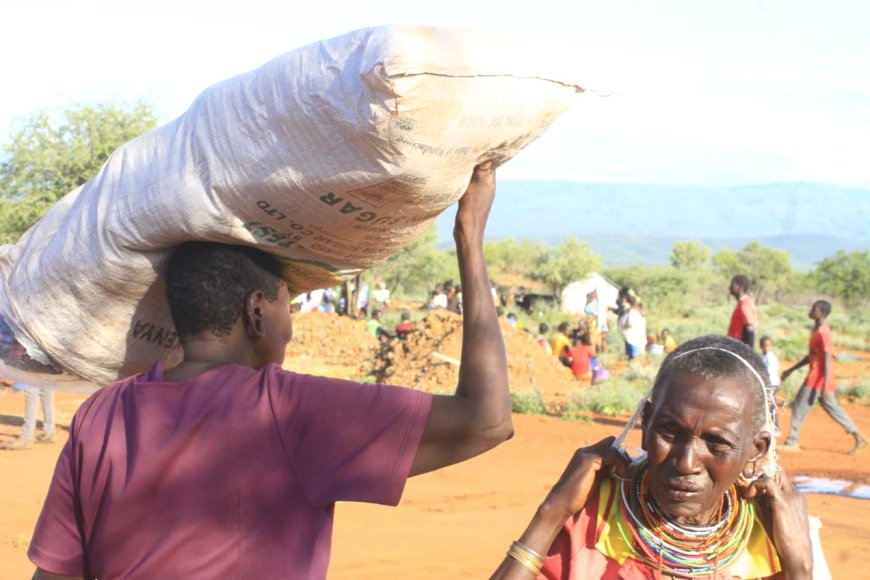
Bandits attack victims who fled their homes in volatile Mukutani, Baringo South converge to receive donations from government and partners. /Photo credits: Joseph Kangogo
For two decades, Mukutani in Baringo South was effectively a no-go zone, rendered uninhabitable due to relentless banditry attacks. Over 500 households from the Ilchamus, Pokot, and Tugen communities were displaced, fleeing their ancestral lands after heavily armed raiders took over the expansive area.
On April 8, 2025, the long-displaced residents joyfully returned home, settling temporarily at Muruai Olkidemi Internally Displaced Persons (IDP) camp in Makutani. The camp hosts families from diverse communities, with the majority being Ilchamus, Tugen, and Pokot, all returning from regions including Eldume in Marigat, Kiserian, and Laikipia where they had taken refuge since 2005.
“Guns have suddenly gone silent. We thank God we have peace now here in Makutani, people are happy to be back home,” said resident Wesley Leshian.
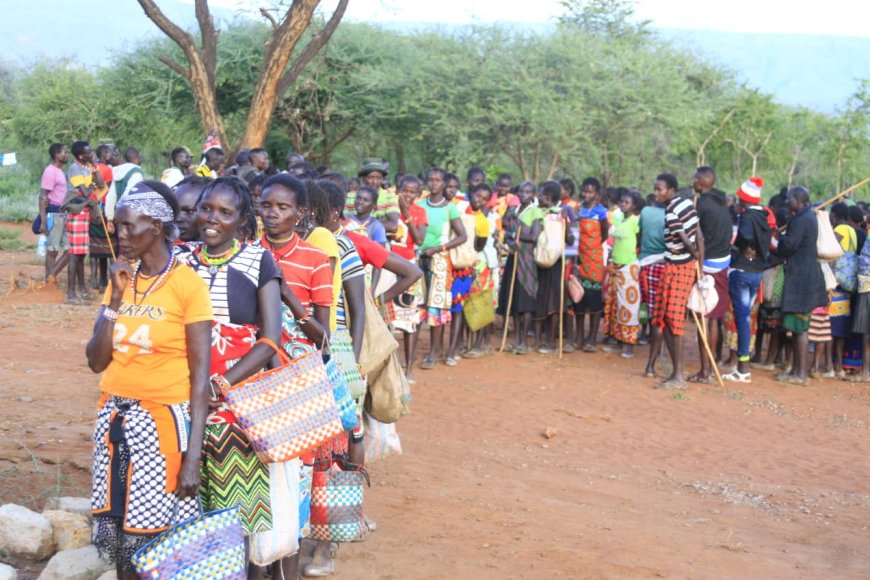
Hundreds of bandit attack returnees of Mukutani, Baringo lineup to receive food and non-food donations from state and well-wishers.
The decades of insecurity were largely attributed to boundary disputes, political tensions, livestock theft, and competition over grazing land, which fueled retaliatory attacks. The creation of Makutani Sub-county by President William Ruto, alongside Baringo West, Tiaty East, and Tiaty West, has been a key step toward restoring governance and security in the once war-torn region.
The new administrative units now enjoy full government services, including Deputy County Commissioners (DCCs), Officers Commanding Stations (OCS), Officers Commanding Police Divisions (OCPD), and other public offices. Police recruitment drives and national holiday celebrations, such as Madaraka Day, have been held in these regions for the first time since Kenya’s independence in 1963.
Mukutani Ward Member of County Assembly (MCA) Paul Lolkisoi welcomed the resettlement, highlighting the hardships faced by displaced residents.
“Our people have actually been on the run for the last 20 years. Families have broken up and lost properties worth millions,” he said. He also noted that while the makeshift camp provides temporary shelter, there remains a pressing need for food and essential supplies.
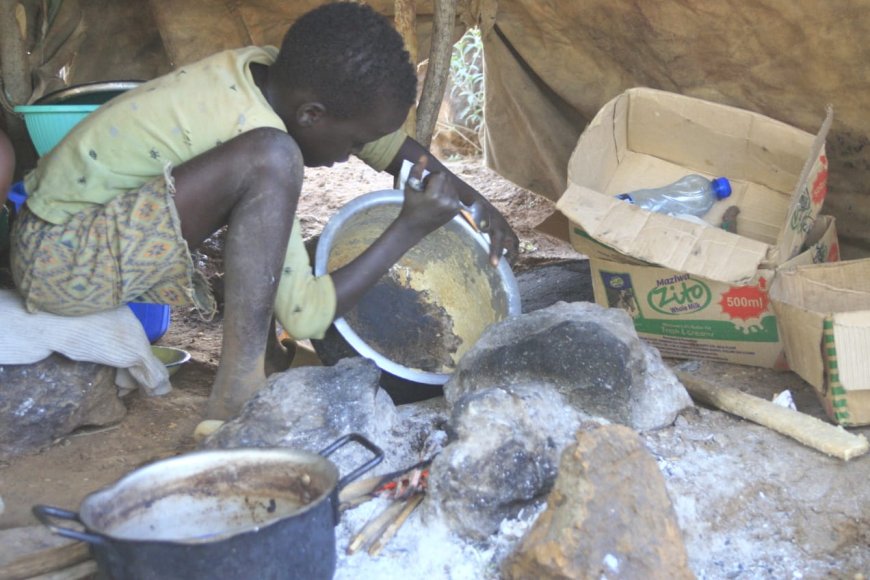
A girl preparing an evening meal inside a makeshift tent at Mukutani returnees camp in Baringo South.
Humanitarian organizations have stepped in to support the returnees. Faridah Haji from Boresha DT Sacco, while donating assorted goods, lauded the unprecedented peace among historically warring communities.
“It is wonderful to see once conflicting Ilchamus, Tugen, and Pokot communities coming together to receive aid in one meeting,” Haji said. She emphasized the importance of peace, love, and unity as the foundation for recovery.
Baringo South, plagued by drought and resource scarcity, has long challenged residents’ ability to sustain livelihoods. Haji encouraged the communities to adopt sustainable farming practices now that peace has returned, presenting an opportunity for renewal.
Baringo County Commissioner Steve Sangalo Kutwa expressed optimism that schools long closed since 2005—such as Rugus, Nosukuro, Ngalecha, Ramacha ECD, Karma ECD, and Katilomwo ECD—would soon reopen, addressing the lost educational opportunities for a generation of children.
Kenya National Union of Teachers (KNUT) Baringo branch Executive Secretary Bishop Joshua Cheptarus affirmed that teachers are ready to return, provided the government ensures continued security.
“Commitment is paramount to restoring peace and security to enable children and teachers to resume classes,” she said.
Security presence in the region has been strengthened with a high-alert contingent comprising a military camp, General Service Unit (GSU), Rapid Deployment Unit (RDU), Anti-Stock Theft Unit (ASTU), Kenya Forest Service (KFS), and National Police Reservists from local communities.
Baringo County Police Commander Julius Kiragu warned that any attempts to disrupt the newfound peace would be met with the full force of the law.
“Peace is not negotiable. People must learn to live and coexist with their neighbors to foster economic development,” he said.
Local leaders and well-wishers, including Sarubi Ambu, chairlady of Ilchamus Women Development Group (IWDG), commended the government and supporting organizations for their efforts, which are crucial in aiding vulnerable groups including women, children, and the elderly.
Despite progress, Baringo County’s long history of insecurity and inter-communal conflict continues to pose challenges. Frequent cattle rustling, killings, and displacement have stifled development and created a climate of fear. Recent government interventions, including security camps established in 2024, aim to address these threats, though National Assembly Speaker Moses Wetangula stressed that sustainable peace requires direct engagement with communities, not just security deployments.
Interior Cabinet Secretary Kipchumba Murkomen also highlighted the need to address conflicts arising from administrative boundaries, pointing to ongoing tensions in neighboring regions as contributing factors to insecurity.
The road to recovery in Mukutani is laden with challenges. Incidents of banditry in the area, such as the killing of Gabriel Lekichep in 2021 and prior attacks in 2014 and 2024, illustrate the risks these communities have faced. The creation of Mukutani Sub-county represents a significant step in addressing historic grievances and empowering residents to advocate for their rights.
As displaced communities reclaim their ancestral lands, the collective efforts of the government, local leaders, humanitarian agencies like the Red Cross, and community members will be crucial to rebuilding lives and fostering lasting peace.
“We thank God for bringing you home. We believe you will settle down and live well and peacefully again,” Haji concluded, underscoring the optimism that now permeates Mukutani after decades of conflict.